Notes · Consciousness & valence · Essay: It From Bit, Revisited
Consciousness research: Maxwell or élan vital?
1 ↗ 500 years ago, it was reasonable to be an electromagnetic skeptic — anyone arguing that “lightning” “lodestones” “static” & “light” were all the same thing and obeyed the same laws was really going out on a limb. After Faraday & Maxwell, this skepticism became less reasonable — it turned out there *was in fact* deep structure to be found in this corner of reality, and characterizing the deep structure offers a lot of predictive power. Maxwell’s equations now power the systems we’re using here to speak about them.
125 years ago, it was reasonable to be an ‘elan vital’ skeptic: philosophers thought living things had a ‘vital energy’ (the latin term is ‘elan vital’) and this special substance was in fact what *made* them living. Some clever philosophers set up experiments which weighed creatures at the moment of their deaths — the thinking was that they’d suddenly become lighter as their elan vital escaped. These experiments failed to find any evidence of elan vital, at which point skepticism about it existing became extremely reasonable — it turned out ‘life’ is easy to treat as more-real than it actually is. Elan vital was a leaky reification; no deep structure to be formally characterized, only confusion to be dissolved.
Which trajectory is ‘consciousness research’ on — Maxwell’s equations or elan vital? My inside-view take is that very clearly it’s the first trajectory: phenomenology has deep structure and this can be formalized and those that deny this are leaving lots of many different kinds of value on the table. I prefer to work on my object-level research as the best argument for this position; “never do metaphysics when you can do physics”. But I’ve written about this directly in (e.g.) Against Functionalism and It From Bit, Revisited.
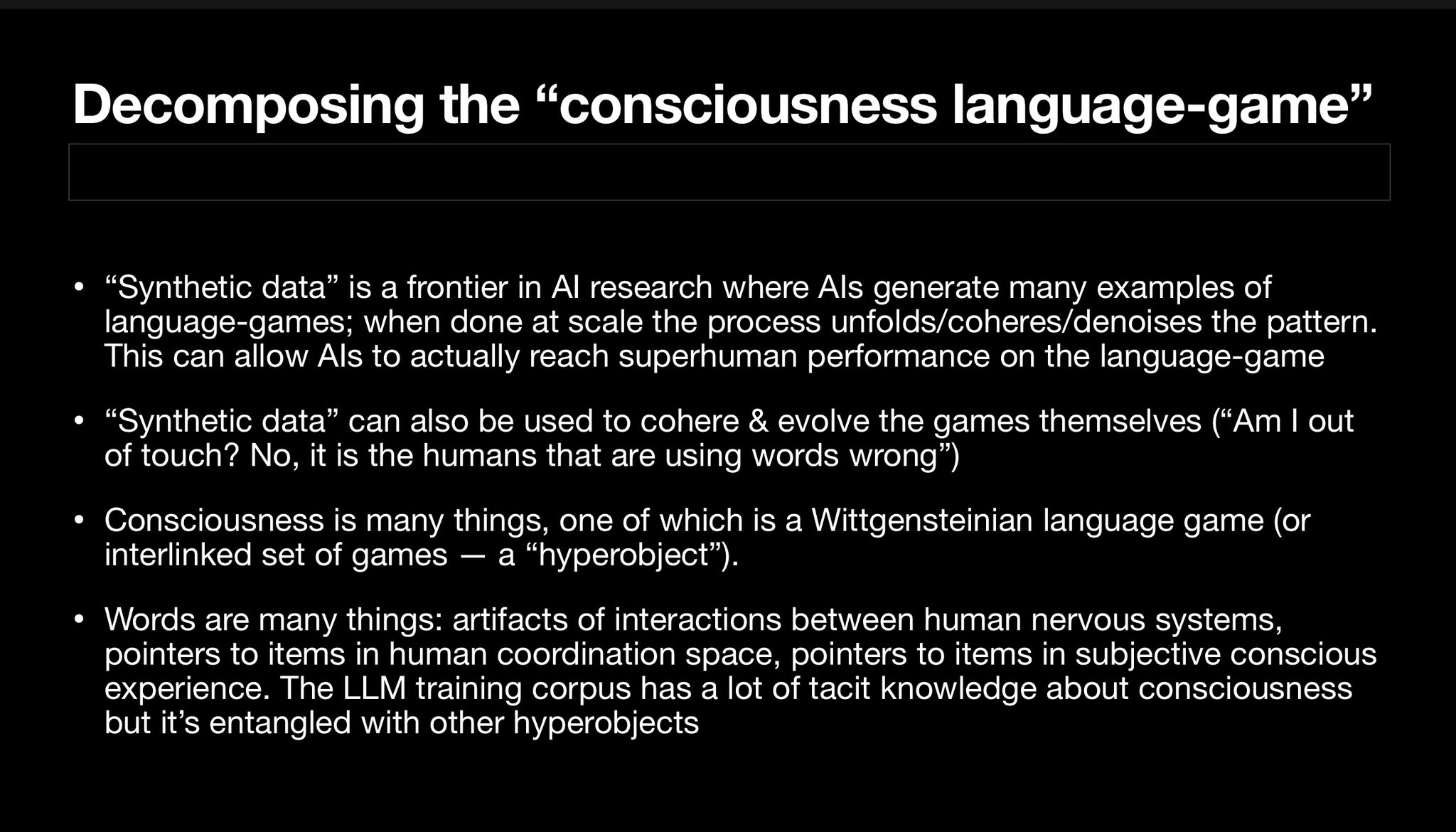
I gave a talk about what I think a research program for consciousness could/should look like at Edge Esmeralda; aiming to write it up as a longform piece sometime soon.