Notes

A container for knowledge

29 tweets + 8 quoted · · source thread

  1. 1
    A few months ago I gave a talk at @joinedgecity on what ‘kind of problem’ consciousness is. The core theme was “to have knowledge [about consciousness] we need a place to put it.”

    Why do I post so much about consciousness? Because I think it’s important. We are building the future much more quickly than we’re sorting out which paths lead to good places. Consciousness research is a crucial source of clarity about what is possible & what is good.

    But I think sometimes people sort of assume that the field is more established than it is — that somewhere there’s a Professional Committee of Very Serious Scientists (perhaps in lab coats) who are carefully tracking progress on understanding the philosophical foundations of consciousness: curating & aggregating knowledge, closing in on the answer, and who would certainly recognize & celebrate a solution to consciousness if they saw it. I can unequivocally say this is not the case.

    The field really is pre-paradigmatic — everybody’s doing their best but most dialogue is people talking past each other, billionaires & PhDs hold roughly the same philosophical views as educated laymen, the academic politics are absolutely brutal to navigate, and there are flashes of deep insight scattered across papers, journals, & conferences but knowledge doesn’t really accrete. It’s alchemy, not chemistry.

    One of the core bottlenecks in formal consciousness research is knowledge accretion: good ideas happen but are often lost (e.g. Helmholtz). I think about this in terms of “to have knowledge [about consciousness] we need a place to put it” — the theme of this talk. Another bottleneck is perseverance; one of the hardest things in the world is to care about something when people around you don’t.

    My answer to both problems is finding better compressions. By reducing the mental RAM needed to store technical concepts we increase our effective working memory; by framing philosophy in simple language we make it intuitive. Alfred North Whitehead suggested “civilization advances by extending the number of important operations which we can perform without thinking about them”; philosophy does too.

    With all that said, here’s my talk; I hope in retrospect people find it really obvious.
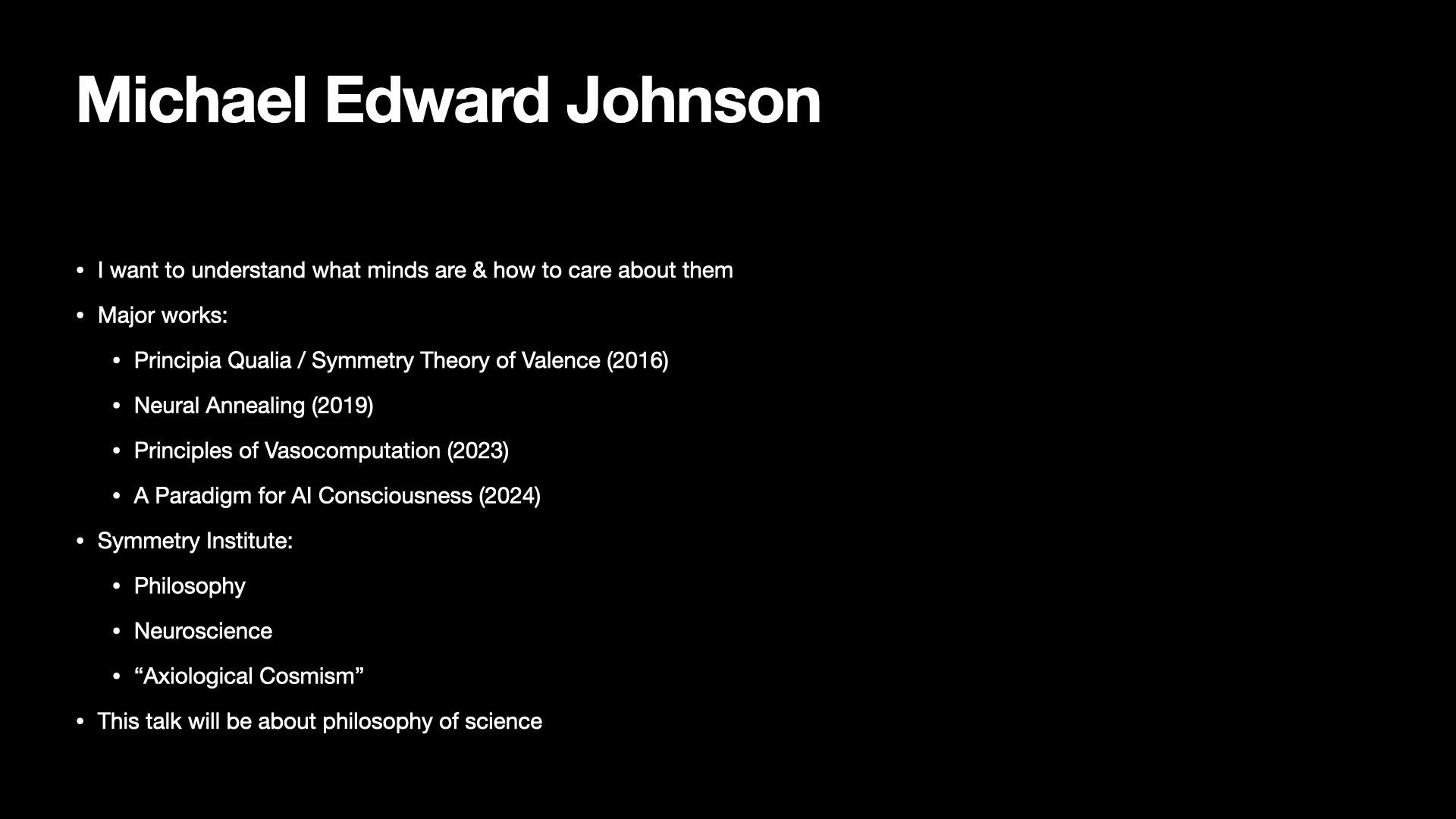
    Image text:
Building a container for knowledge
Foundations for a science of consciousness
Michael Edward Johnson, Symmetry Institute
May 26th, 2025; Edge Esmeralda
V1Image text:
Michael Edward Johnson
• I want to understand what minds are & how to care about them
• Major works:
  • Principia Qualia / Symmetry Theory of Valence (2016)
  • Neural Annealing (2019)
  • Principles of Vasocomputation (2023)
  • A Paradigm for AI Consciousness (2024)
• Symmetry Institute:
  • Philosophy
  • Neuroscience
  • “Axiological Cosmism”
• This talk will be about philosophy of science
  2. 2
    There’s no consensus on what consciousness is or how to study it. But with AI speeding up, “consciousness” is leaving the realm of idle philosophy & entering the realm of important policy unknown. Soon it will be urgent
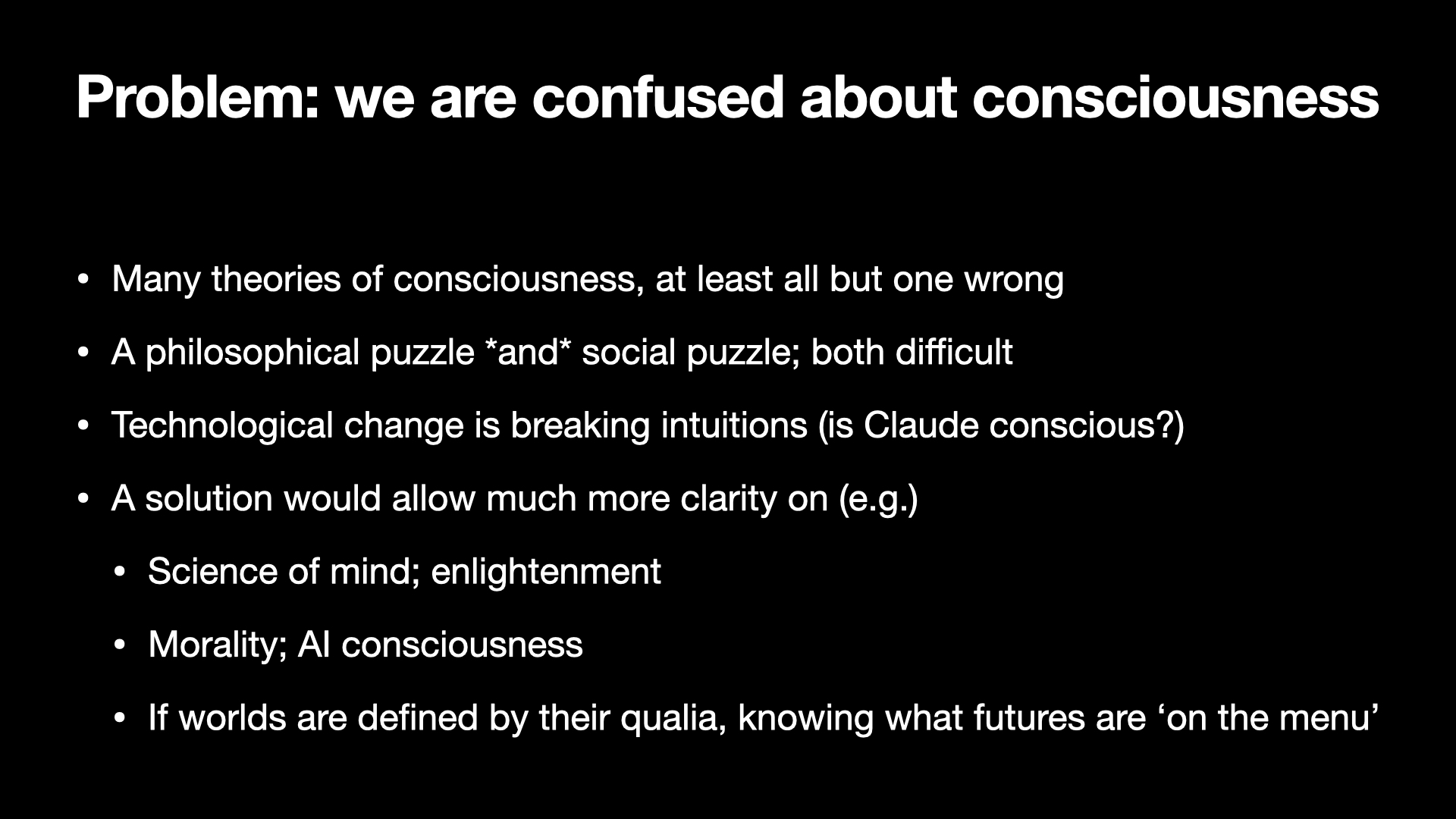
    Image text:
Problem: we are confused about consciousness
• Many theories of consciousness, at least all but one wrong
• A philosophical puzzle and social puzzle; both difficult
• Technological change is breaking intuitions (is Claude conscious?)
• A solution would allow much more clarity on (e.g.)
  • Science of mind; enlightenment
  • Morality; AI consciousness
  • If worlds are defined by their qualia, knowing what futures are ‘on the menu’
  3. 3
    Decades of confusion & neglect have led to the field sinking into learned helplessness. We need fresh & agentic ways of thinking that can antidote this. Themes I endorse:
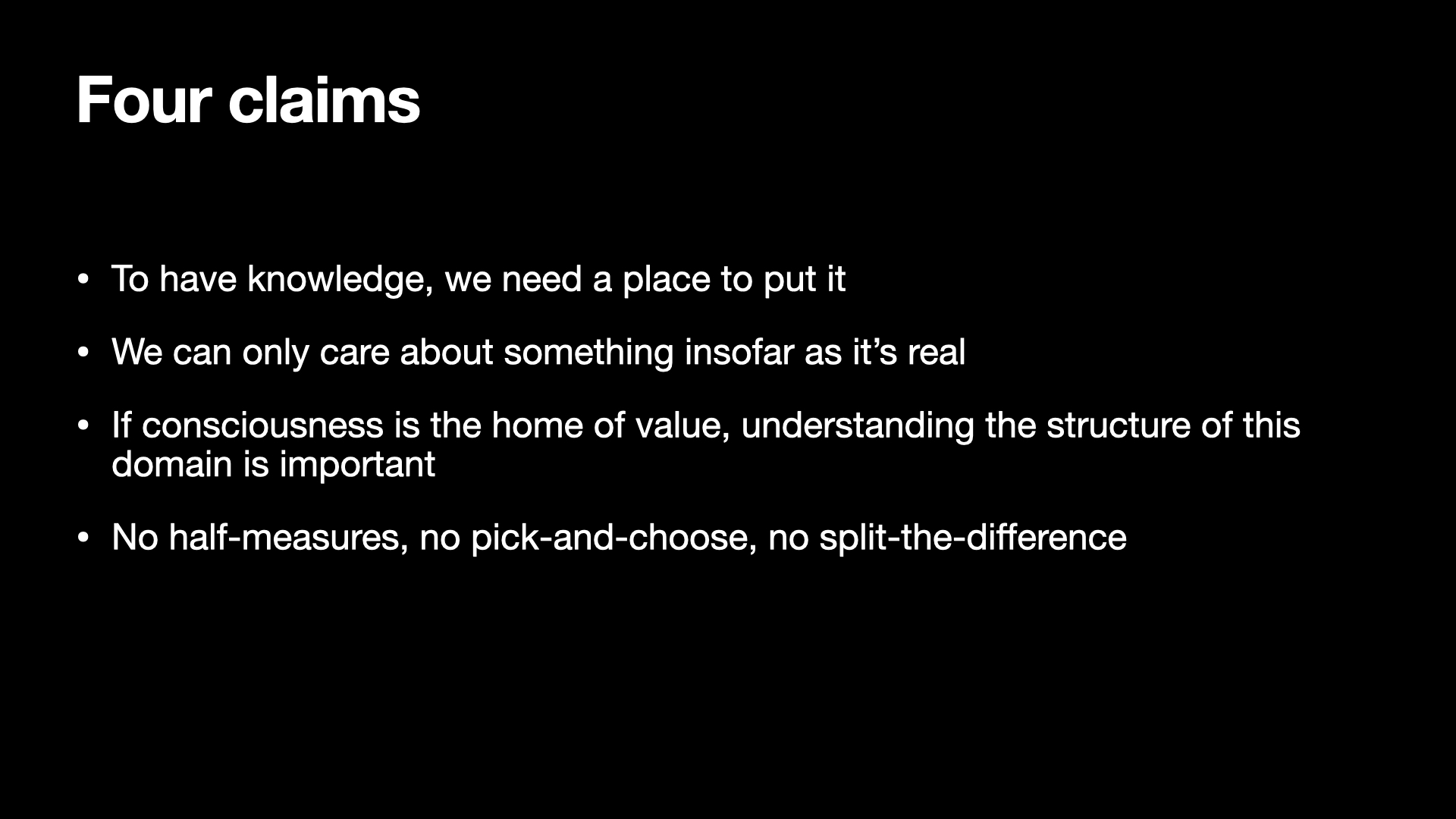
    Image text:
Four claims
• To have knowledge, we need a place to put it
• We can only care about something insofar as it’s real
• If consciousness is the home of value, understanding the structure of this
domain is important
• No half-measures, no pick-and-choose, no split-the-difference
  4. 4
    Basic structure of my talk: seven ways to look at consciousness with fresh eyes & a walk-through of what each means
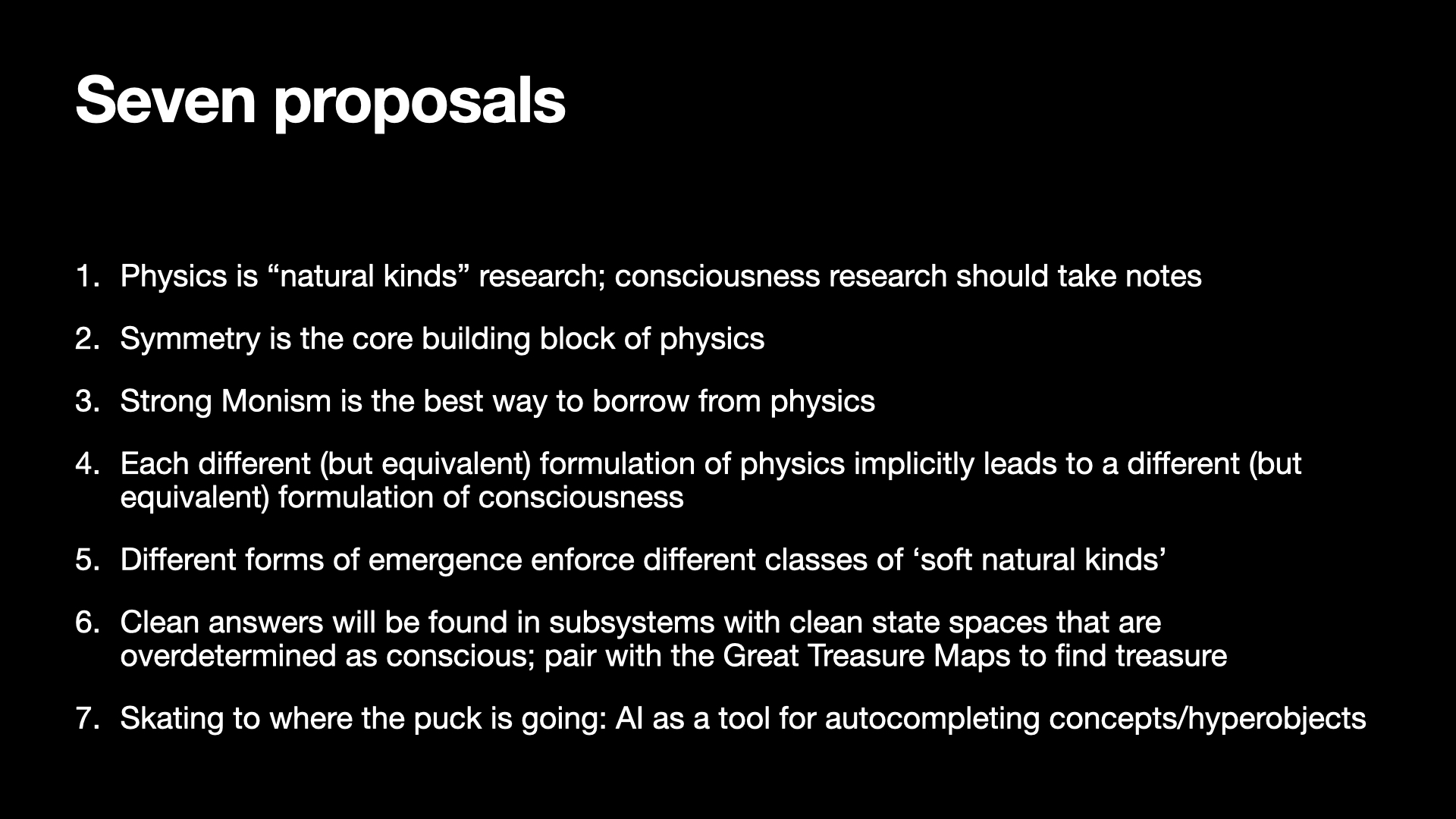
    Image text:
Seven proposals
1. Physics is “natural kinds” research; consciousness research should take notes
2. Symmetry is the core building block of physics
3. Strong Monism is the best way to borrow from physics
4. Each different (but equivalent) formulation of physics implicitly leads to a different (but
equivalent) formulation of consciousness
5. Different forms of emergence enforce different classes of ‘soft natural kinds’
6. Clean answers will be found in subsystems with clean state spaces that are
overdetermined as conscious; pair with the Great Treasure Maps to find treasure
7. Skating to where the puck is going: AI as a tool for autocompleting concepts/hyperobjects
  5. 5
    “Natural kinds” is a term derived from Aristotle; it’s an attempt to point at the fundamental building blocks of reality. Or as Plato put it, concepts that ‘carve reality at its joints’.

    The study of consciousness is the reverse-engineering of qualia natural kinds
    Image text:
I. Natural kinds in physics
  6. 6
    Understanding which domain consciousness naturally ‘lives in’ would greatly help clarify what the natural kinds of consciousness could be

    The two most plausible domains for this are physics & computation. Each leads to very, very different sorts of answers
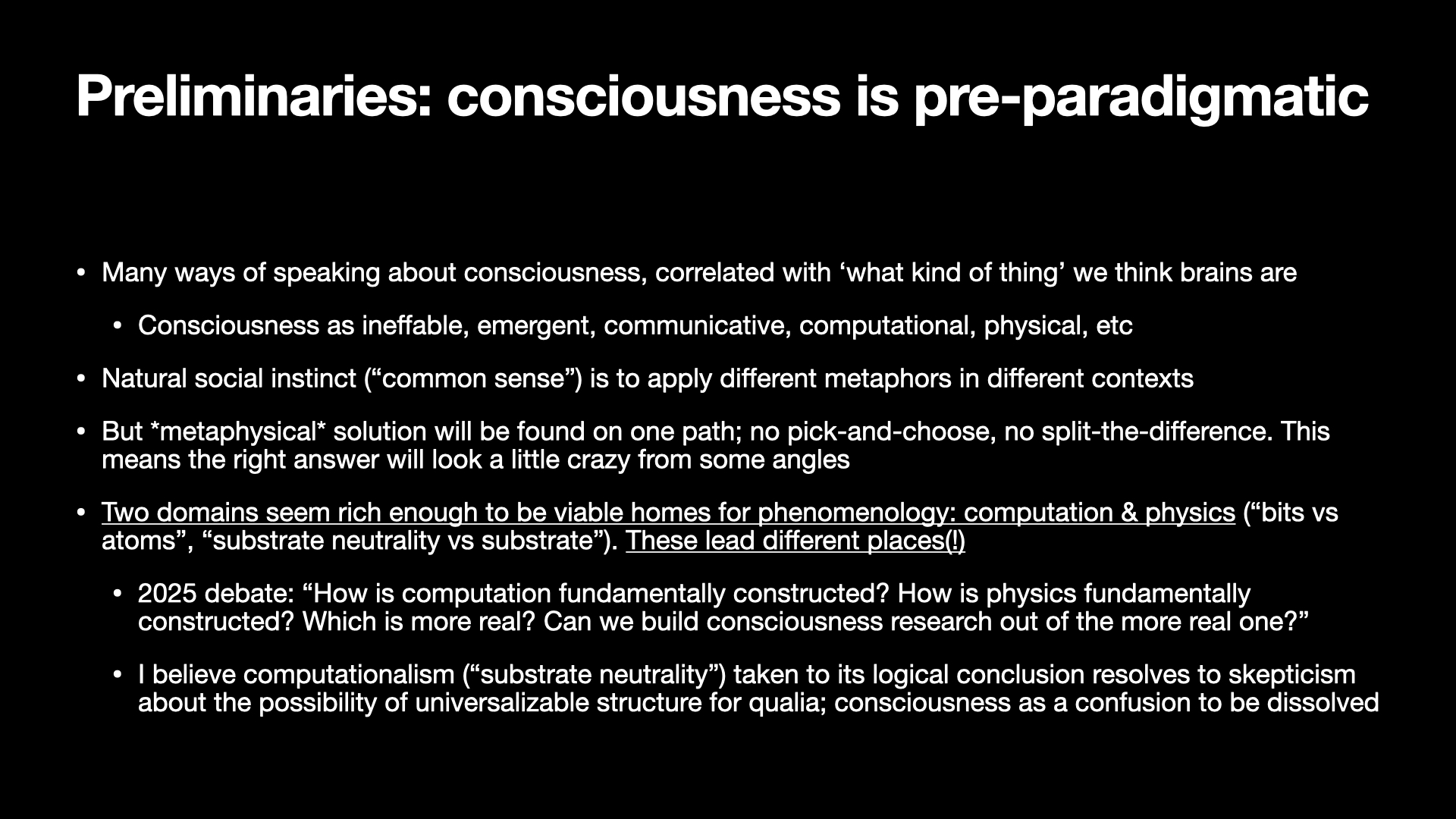
    Image text:
Preliminaries: consciousness is pre-paradigmatic
• Many ways of speaking about consciousness, correlated with ‘what kind of thing’ we think brains are
  • Consciousness as ineffable, emergent, communicative, computational, physical, etc
• Natural social instinct (“common sense”) is to apply different metaphors in different contexts
• But metaphysical solution will be found on one path; no pick-and-choose, no split-the-difference. This means the right answer will look a little crazy from some angles
• Two domains seem rich enough to be viable homes for phenomenology: computation & physics (“bits vs atoms”, “substrate neutrality vs substrate”). These lead different places(!)
  • 2025 debate: “How is computation fundamentally constructed? How is physics fundamentally constructed? Which is more real? Can we build consciousness research out of the more real one?”
  • I believe computationalism (“substrate neutrality”) taken to its logical conclusion resolves to skepticism about the possibility of universalizable structure for qualia; consciousness as a confusion to be dissolved
  7. 7
    Physics is a great accounting system for what exists. If consciousness research wants to be good at this (and it should) it should take notes from physics
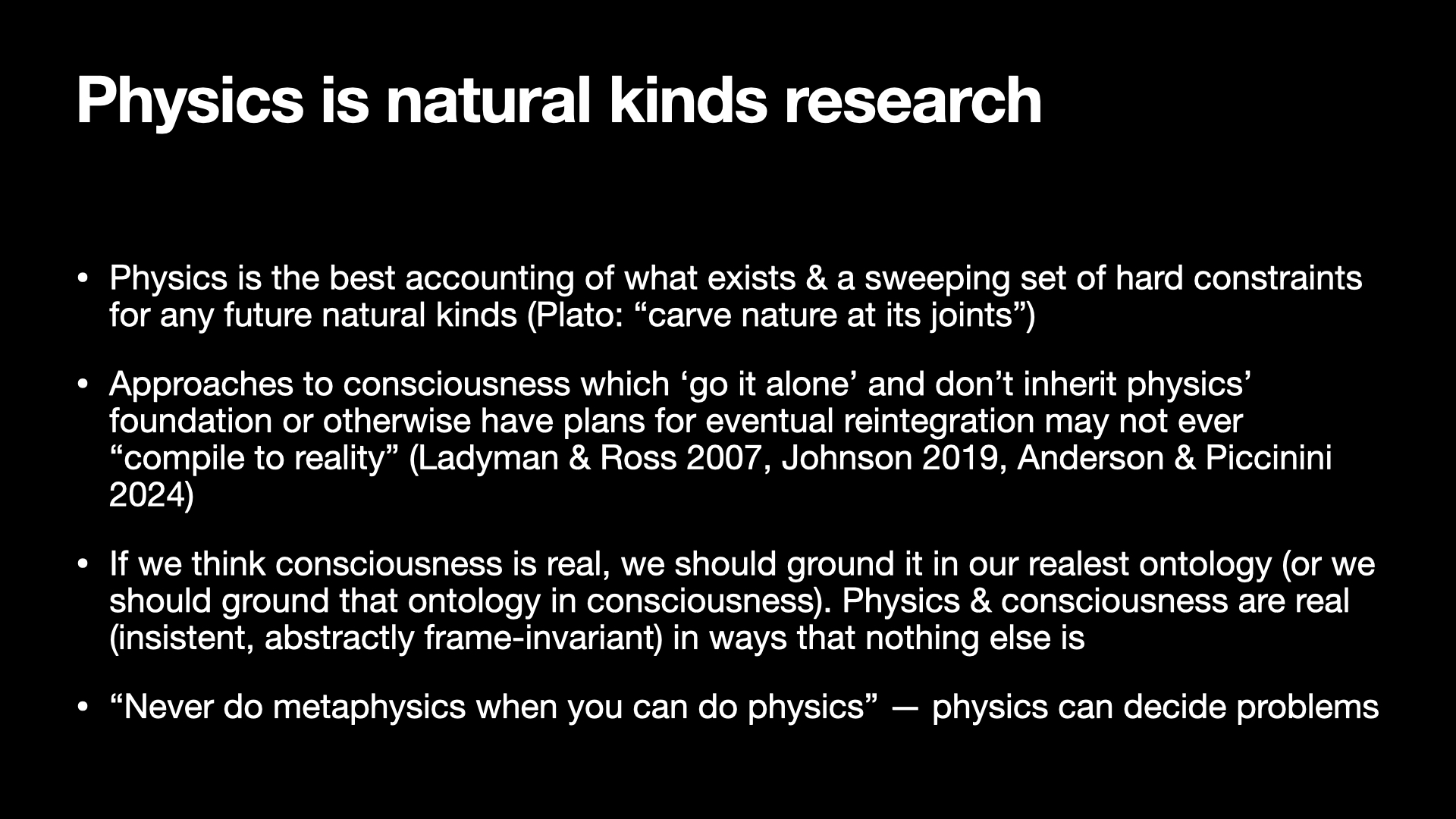
    Image text:
Physics is natural kinds research
• Physics is the best accounting of what exists & a sweeping set of hard constraints
for any future natural kinds (Plato: “carve nature at its joints”)
• Approaches to consciousness which ‘go it alone’ and don’t inherit physics’
foundation or otherwise have plans for eventual reintegration may not ever
“compile to reality” (Ladyman & Ross 2007, Johnson 2019, Anderson & Piccinini
2024)
• If we think consciousness is real, we should ground it in our realest ontology (or we
should ground that ontology in consciousness). Physics & consciousness are real
(insistent, abstractly frame-invariant) in ways that nothing else is
• “Never do metaphysics when you can do physics” — physics can decide problems
  8. 8
    Something that I think people dramatically underestimate is how central “symmetry” is to physics
    Image text:
II. SymmetryImage text:
Symmetry in physics
“Change without change” — invariants & conservation laws
• Wigner, Noether, et al
• Nobel Laureate P. W. Anderson: “It is only slightly overstating the case to say that physics is the study of symmetry.”
• Nobel Laureate Frank Wilczek: “[T]he idea that there is symmetry at the root of Nature has come to dominate our understanding of physical reality. We are led to a small number of special structures from purely mathematical considerations—considerations of symmetry—and put them forward to Nature, as candidate elements for her design. […] In modern physics we have taken this lesson to heart. We have learned to work from symmetry toward truth. Instead of using experiments to infer equations, and then finding (to our delight and astonishment) that the equations have a lot of symmetry, we propose equations with enormous symmetry and then check to see whether Nature uses them. It has been an amazingly successful strategy.” (Wilczek 2016)
  9. 9
    STV is a serious attempt to replace an enormous and complicated chunk of reasoning & logic (conventional approaches to understanding what pain & pleasure are, & why they’re so deeply linked with motivation) with something very simple. As I describe it in my 2023 paper:

    >The Symmetry Theory of Valence is both aggressive and simple. It’s aggressive in that it purports to offer an exact, single-factor solution to one of the oldest mysteries in phenomenology, what makes some things feel better than others. It’s simple in that it fits in one sentence, merely combining three concepts: (1) information geometries of mind, (2) symmetry, and (3) valence. Each pairwise connection is already strong:

    >• 1+2: The history of physics and mathematics gives us a strong prior to analyze information
    geometries of mind in light of symmetry;
    >• 1+3: By definition, information geometries of mind fully describe a mind’s valence;
    >• 2+3: There’s a long cultural history of understanding pleasantness and beauty in terms of
    symmetry.

    >As with any novel theory, it would be strange if STV was true. But I hold that it would be even
    more strange – there would be some deep violation of beauty somewhere – if it wasn’t.

    https://x.com/johnsonmxe/status/1800919946710667453

    https://opentheory.net/Qualia_Formalism_and_a_Symmetry_Theory_of_Valence.pdf
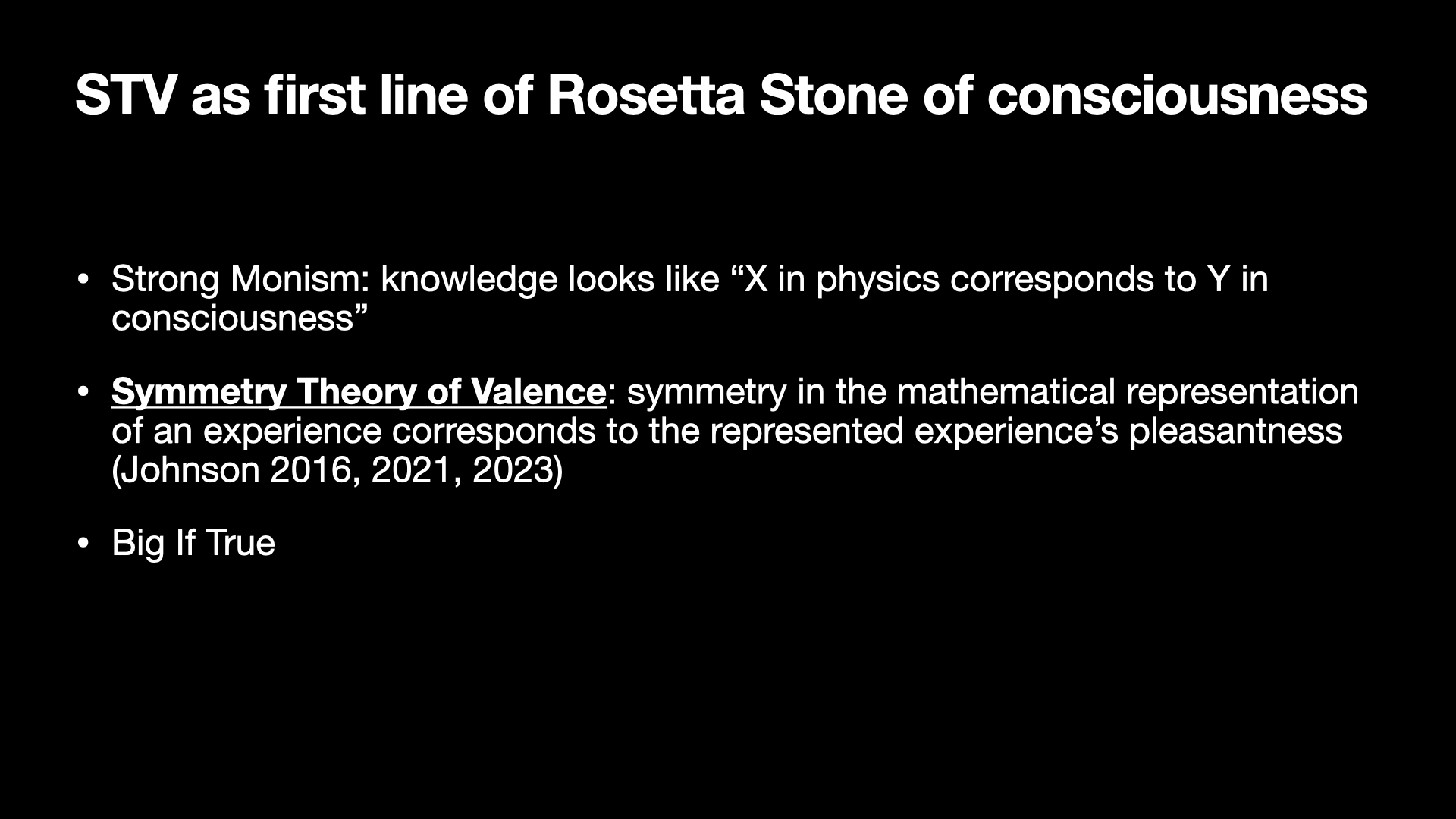
    Image text:
STV as first line of Rosetta Stone of consciousness
• Strong Monism: knowledge looks like “X in physics corresponds to Y in
consciousness”
• Symmetry Theory of Valence: symmetry in the mathematical representation
of an experience corresponds to the represented experience’s pleasantness
(Johnson 2016, 2021, 2023)
• Big If True
  10. 10
    “Strong Monism” is the maximally opinionated take on “dual aspect monism” or Russell’s “neutral monism”. I contrast it with “Weak Monism”. You would rather be a Strong Monist than a Weak Monist, yes?

    https://opentheory.net/2019/06/taking-monism-seriously/
    Image text:
III. Strong Monism
  11. 11
    The outgrowth of Strong Monism is that *if physics and consciousness derive from the same thing, we actually know a lot about consciousness* & mining physics for insight should be a primary heuristic

    Weak & Strong Monism pay the same ontological costs; why not go with Strong?
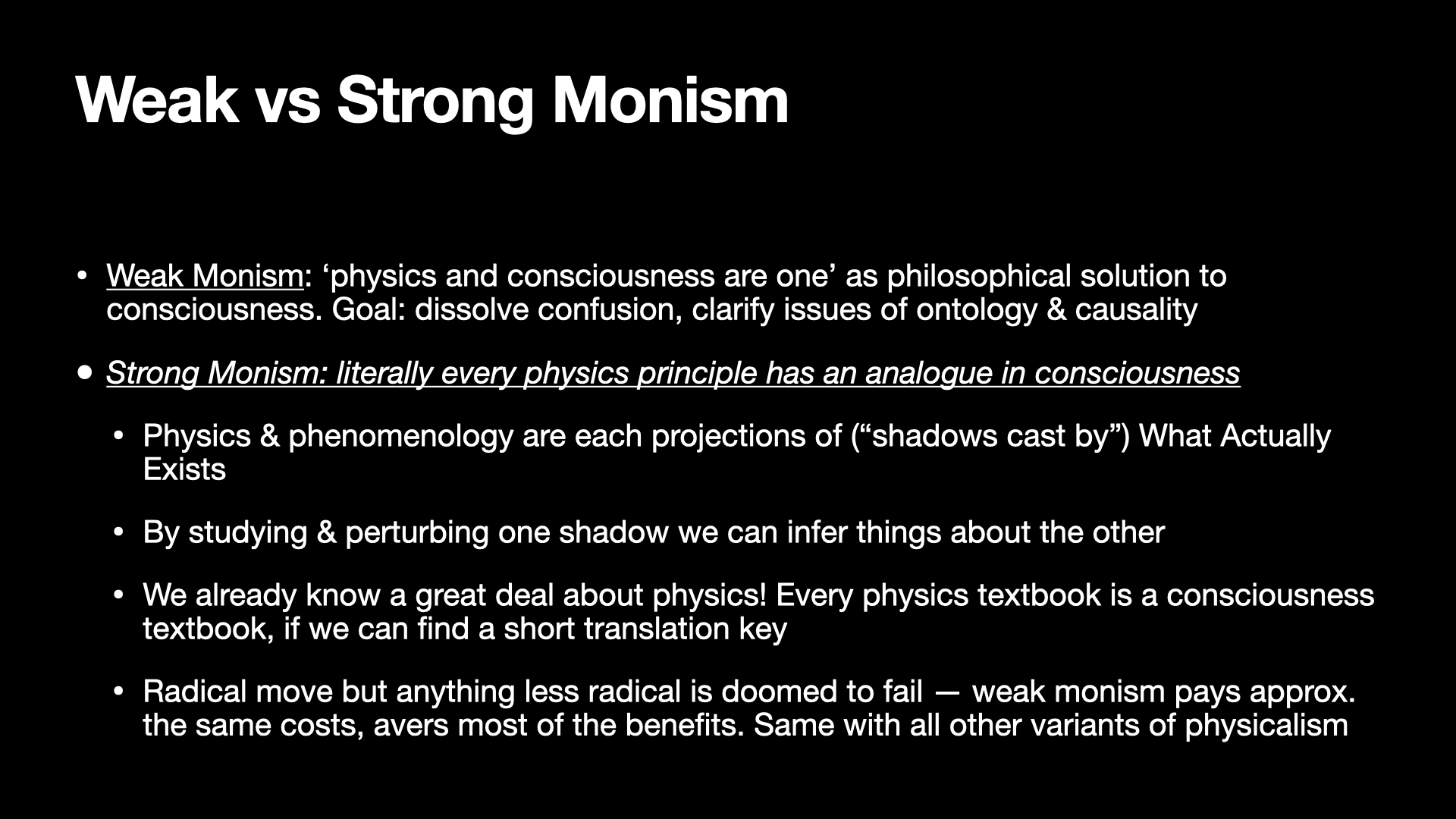
    Image text:
Weak vs Strong Monism
• Weak Monism: ‘physics and consciousness are one’ as philosophical solution to consciousness. Goal: dissolve confusion, clarify issues of ontology & causality
• Strong Monism: literally every physics principle has an analogue in consciousness
  • Physics & phenomenology are each projections of (“shadows cast by”) What Actually Exists
  • By studying & perturbing one shadow we can infer things about the other
  • We already know a great deal about physics! Every physics textbook is a consciousness textbook, if we can find a short translation key
  • Radical move but anything less radical is doomed to fail — weak monism pays approx. the same costs, avers most of the benefits. Same with all other variants of physicalism
  12. 12
    I think Strong Monism is an incredibly optimistic frame because it both clearly defines what a “solution to consciousness” could be & offers hope that this could be years away, not millennia
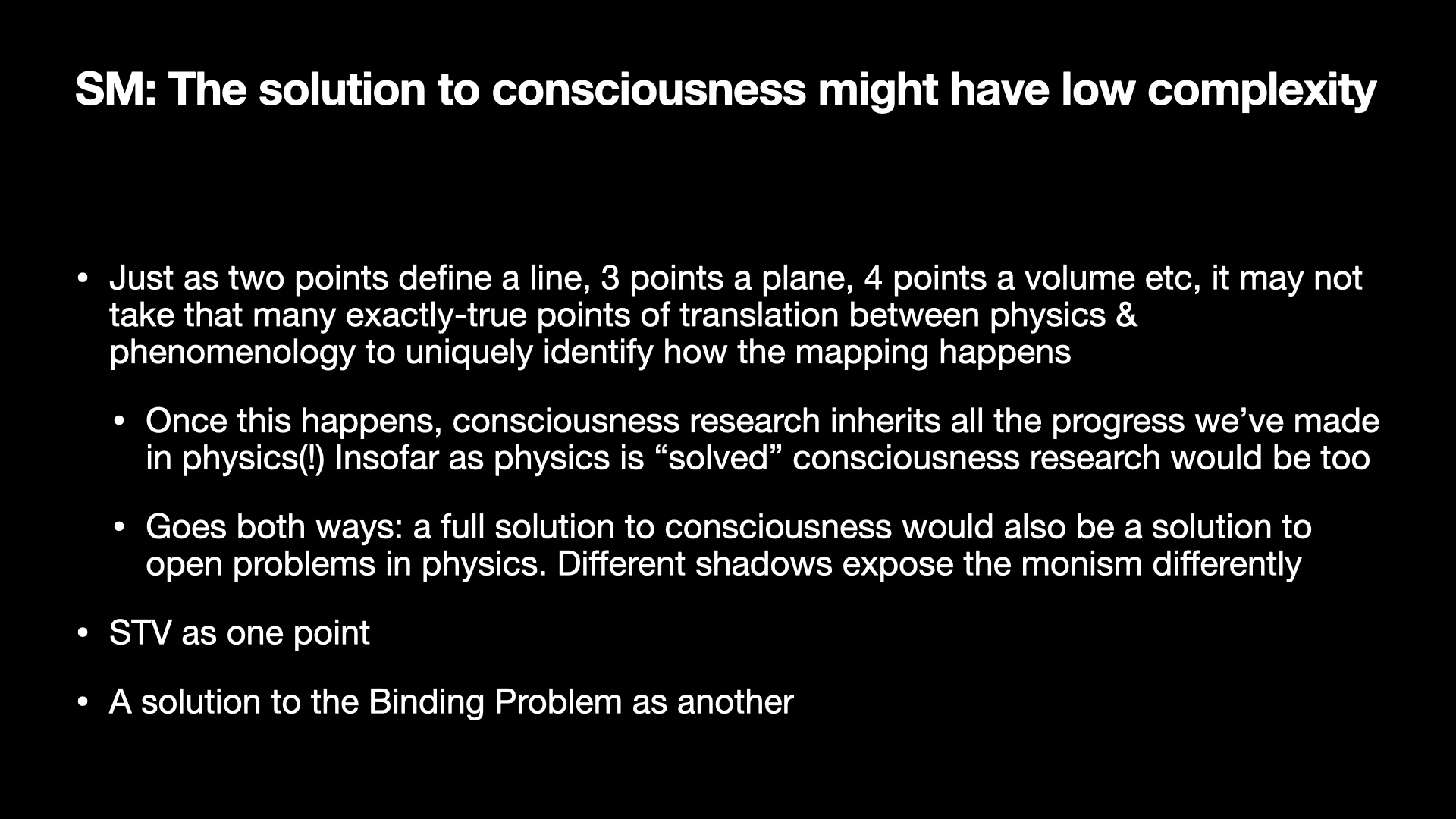
    Image text:
SM: The solution to consciousness might have low complexity
• Just as two points define a line, 3 points a plane, 4 points a volume etc, it may not take that many exactly-true points of translation between physics & phenomenology to uniquely identify how the mapping happens
  • Once this happens, consciousness research inherits all the progress we’ve made in physics(!) Insofar as physics is “solved” consciousness research would be too
  • Goes both ways: a full solution to consciousness would also be a solution to open problems in physics. Different shadows expose the monism differently
• STV as one point
• A solution to the Binding Problem as another
  13. 13
    The dirty secret of “physics” is there isn’t one theory of physics, there are many competing theories. How does this impact physics-based consciousness research?
    Image text:
IV. Versions of physics
  14. 14
    I expect there to be as many formulations of consciousness as there are formulations of physics. This makes getting one’s bearings a little hard at first but it’ll pay dividends later since some formulations of physics are better at certain problems than others
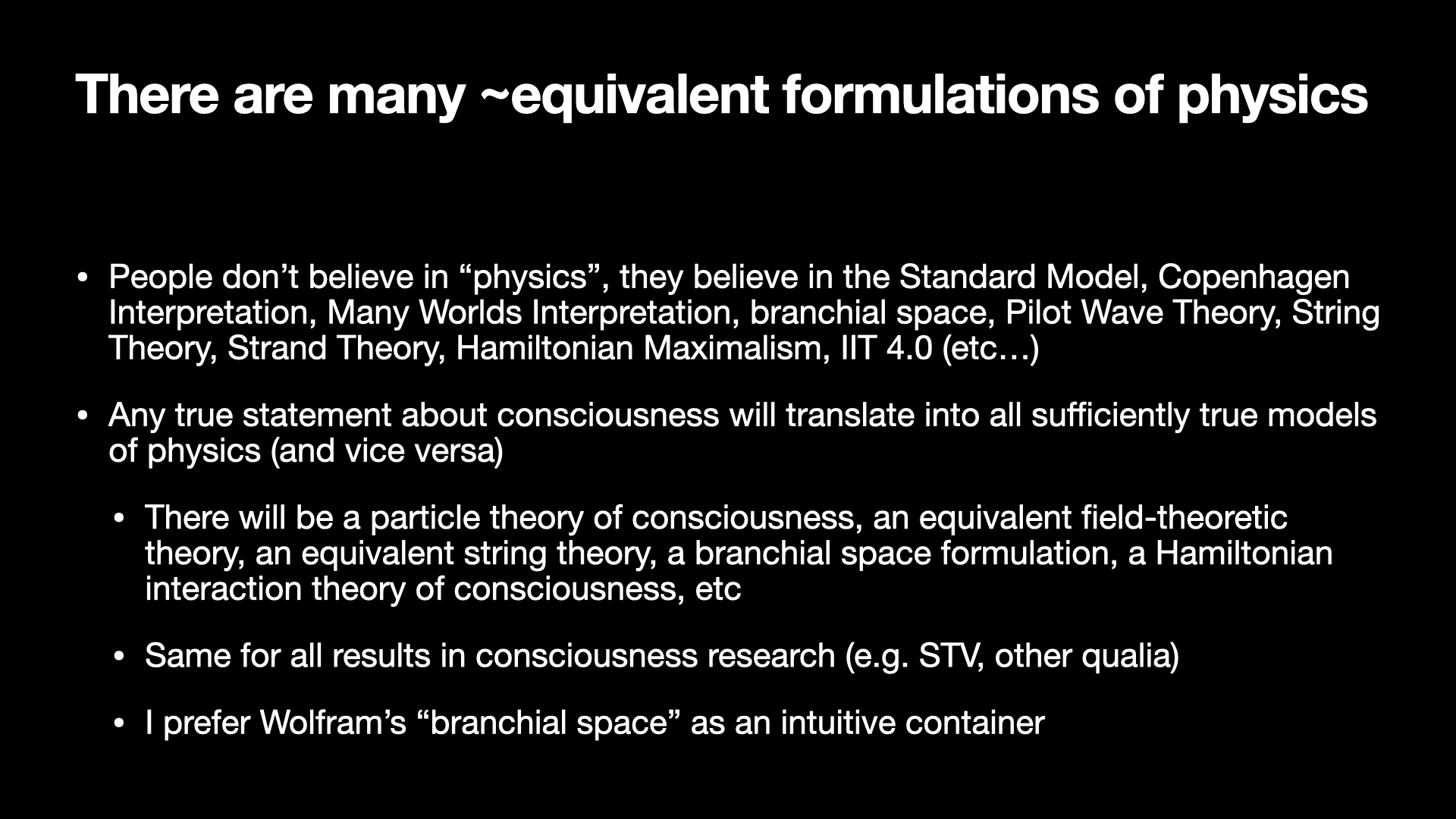
    Image text:
There are many ~equivalent formulations of physics
• People don't believe in "physics", they believe in the Standard Model, Copenhagen
Interpretation, Many Worlds Interpretation, branchial space, Pilot Wave Theory, String
Theory, Strand Theory, Hamiltonian Maximalism, IIT 4.0 (etc...)
• Any true statement about consciousness will translate into all sufficiently true models
of physics (and vice versa)
• There will be a particle theory of consciousness, an equivalent field-theoretic
theory, an equivalent string theory, a branchial space formulation, a Hamiltonian
interaction theory of consciousness, etc
• Same for all results in consciousness research (e.g. STV, other qualia)
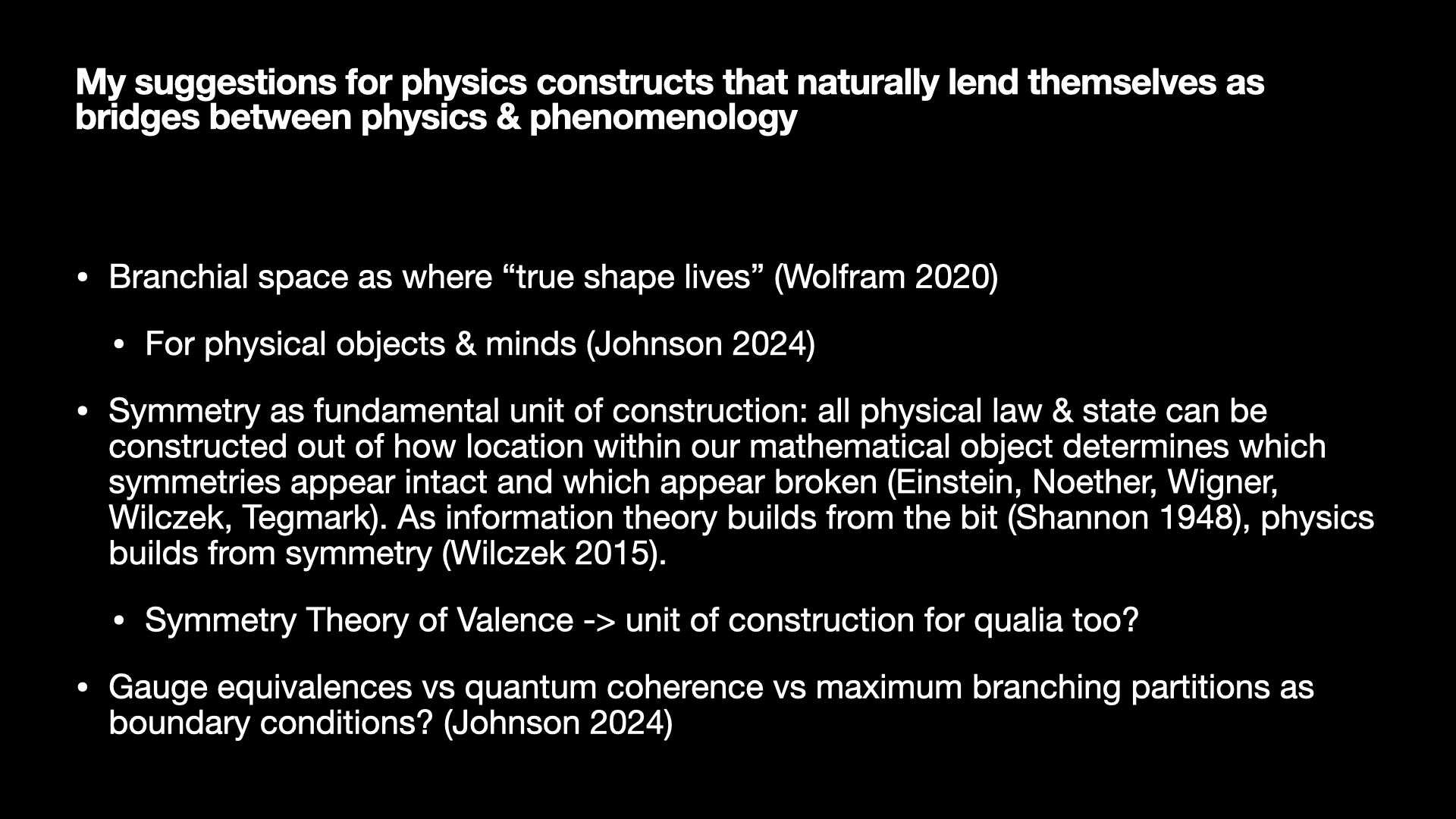
• I prefer Wolfram's "branchial space" as an intuitive container
  15. 16
    “Emergence” is often used as a sort of magical evocation; life “emerges” from physics, consciousness “emerges” from complexity. This is not illuminating. But emergence can be a deeply useful technical frame
    Image text:
V. Emergence
  16. 17
    @erikphoel has a great formal method for this in “Causal Emergence 2.0”. His basic thesis: we can quantify the uncertainty about causes & effects across different scales; emergence happens when & insofar as macroscopic scales have more certainty vs micro
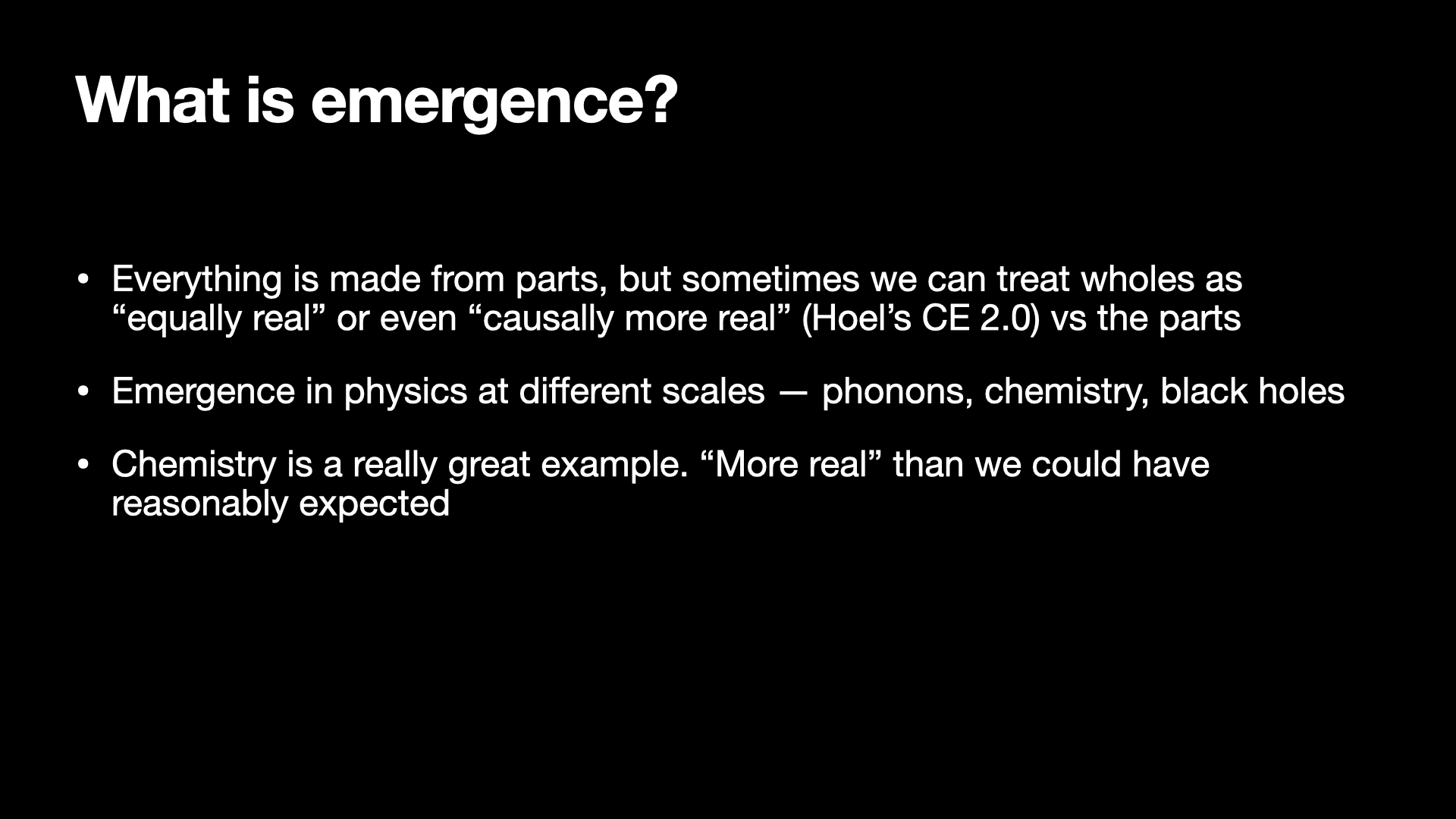
    Image text:
What is emergence?
• Everything is made from parts, but sometimes we can treat wholes as
"equally real" or even "causally more real" (Hoel's CE 2.0) vs the parts
• Emergence in physics at different scales — phonons, chemistry, black holes
• Chemistry is a really great example. "More real" than we could have
reasonably expected
  17. 18
    Chemistry is a fantastic emergent structure; a true jewel of science. People interested in understanding consciousness should study *why* chemistry works
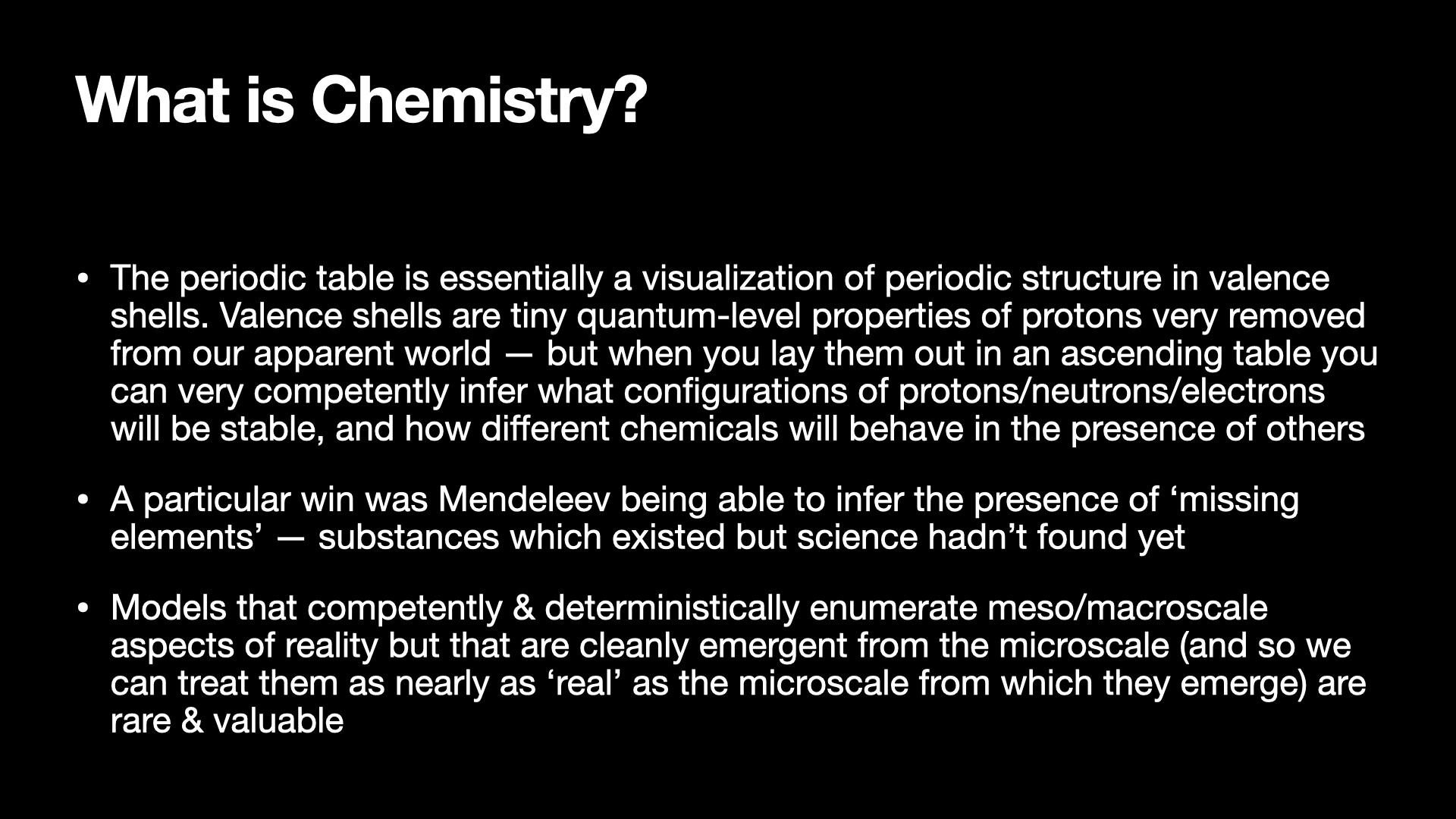
    Image text:
What is Chemistry?
• The periodic table is essentially a visualization of periodic structure in valence
shells. Valence shells are tiny quantum-level properties of protons very removed
from our apparent world — but when you lay them out in an ascending table you
can very competently infer what configurations of protons/neutrons/electrons
will be stable, and how different chemicals will behave in the presence of others
• A particular win was Mendeleev being able to infer the presence of 'missing
elements' — substances which existed but science hadn't found yet
• Models that competently & deterministically enumerate meso/macroscale
aspects of reality but that are cleanly emergent from the microscale (and so we
can treat them as nearly as 'real' as the microscale from which they emerge) are
rare & valuable
  18. 19
    Many fields have physics envy. Consciousness research should have chemistry envy & biology envy

    I introduce the term “monist shadow” here; I hope to write more soon
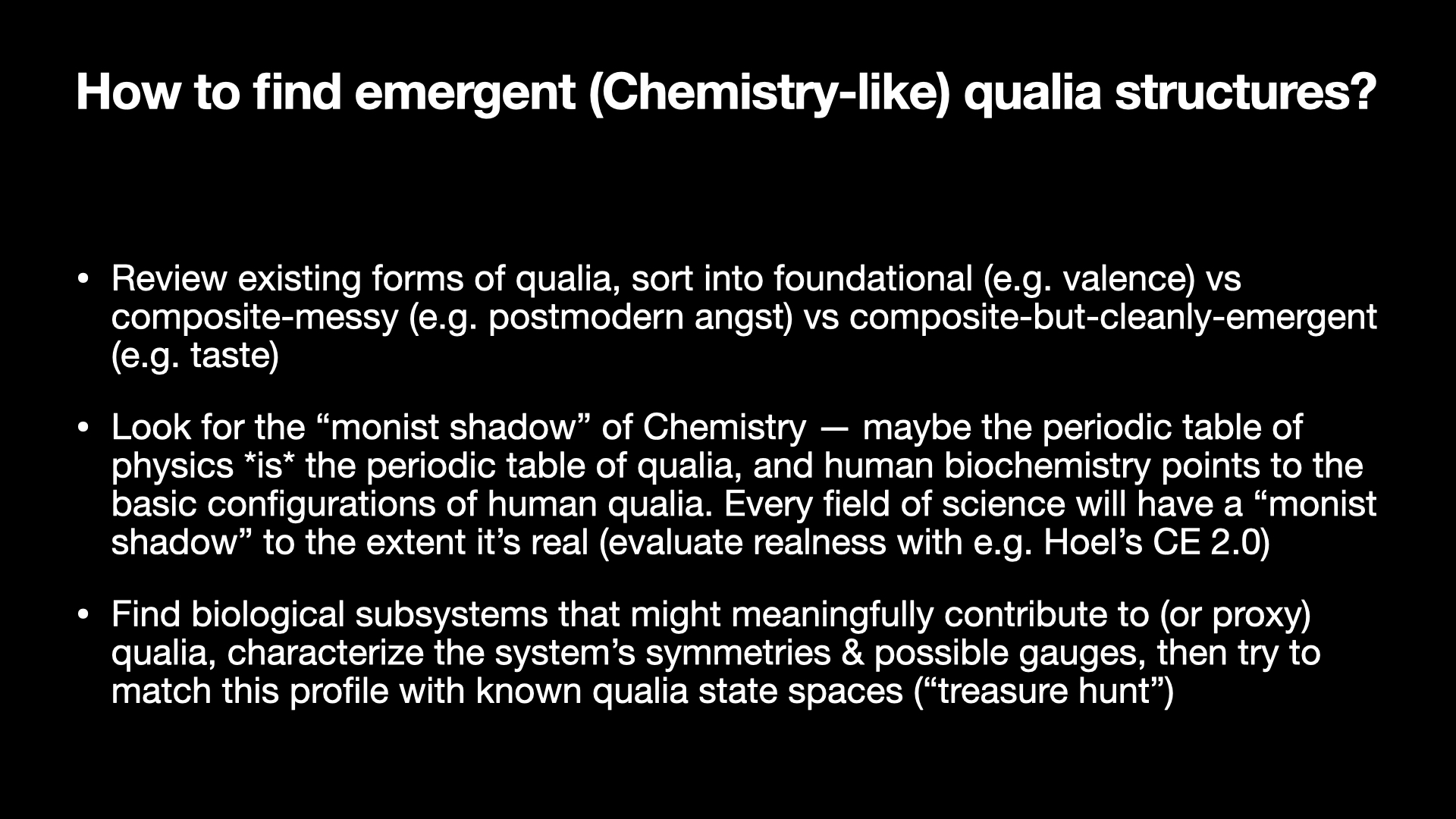
    Image text:
How to find emergent (Chemistry-like) qualia structures?
• Review existing forms of qualia, sort into foundational (e.g. valence) vs composite-messy (e.g. postmodern angst) vs composite-but-cleanly-emergent (e.g. taste)
• Look for the “monist shadow” of Chemistry — maybe the periodic table of physics is the periodic table of qualia, and human biochemistry points to the basic configurations of human qualia. Every field of science will have a “monist shadow” to the extent it’s real (evaluate realness with e.g. Hoel’s CE 2.0)
• Find biological subsystems that might meaningfully contribute to (or proxy) qualia, characterize the system’s symmetries & possible gauges, then try to match this profile with known qualia state spaces (“treasure hunt”)
  19. 20
    A few words foreshadowing the next section & a new project I've been developing, working name “QPT”
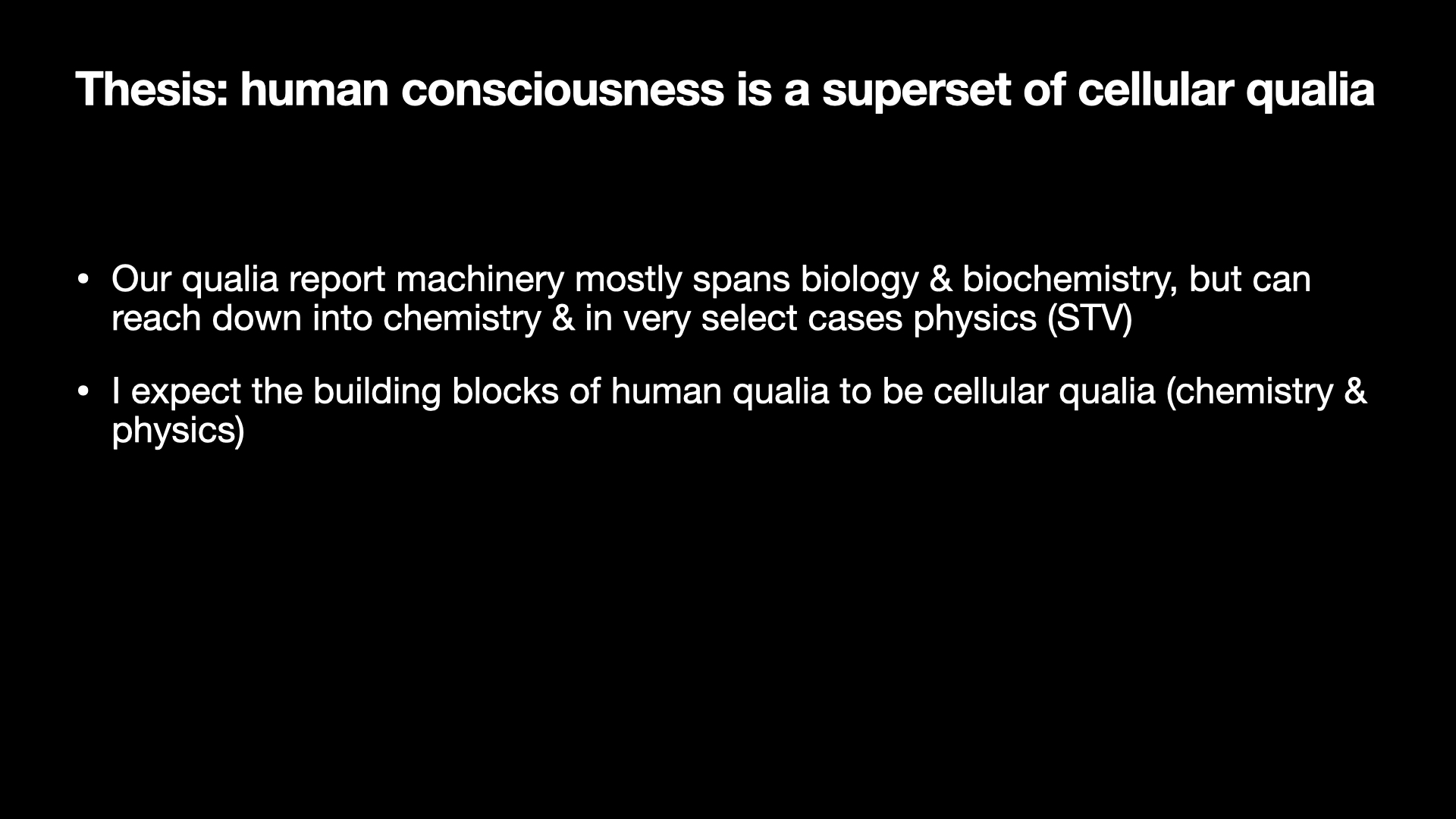
    Image text:
Thesis: human consciousness is a superset of cellular qualia
• Our qualia report machinery mostly spans biology & biochemistry, but can reach down into chemistry & in very select cases physics (STV)
• I expect the building blocks of human qualia to be cellular qualia (chemistry & physics)
  20. 21
    It’s crucial to have treasure maps for research; without them we simply won’t find the important stuff. But constructing useful maps requires a bit of cleverness
    Image text:
VI. Treasure maps
  21. 22
    It’s always hard to reify a research heuristic into a process that can be shared, extended, scaled. But here’s what I think will work to create treasure maps:
    Image text:
Proposed treasure hunt
• Look for subsystems with clean state spaces that are overdetermined as conscious (or sensitively proxied to local consciousness), pair with the Great Treasure Maps of phenomenology
• “Overdetermined as conscious” — quantum coherence, branchial width, EM pockets & differentials & flows, integrated information, world model, etc! Find biological subsystems that check all the boxes, or plausible tight proxies (e.g. cristae alignment)
• Great Treasure Maps: Buddhism, valence, CIELAB, Jung, etc.
  • X physical domain <=> Y treasure map domain
  • Categorize the symmetries / gauges of the domains! (Johnson, Kanai, etc)
    Vasocomputation as the story of the vasomuscular & nervous systems as joint orchestrators of cells-as-qualia-pixels [pixel value defined by symmetries]
  22. 23
    The overlap between consciousness research & AI will define much of the 2030s. I wrote extensively about AI consciousness in last year’s A Paradigm for AI Consciousness. It seems pretty pressing to figure out.
    https://opentheory.net/2024/06/a-paradigm-for-ai-consciousness/
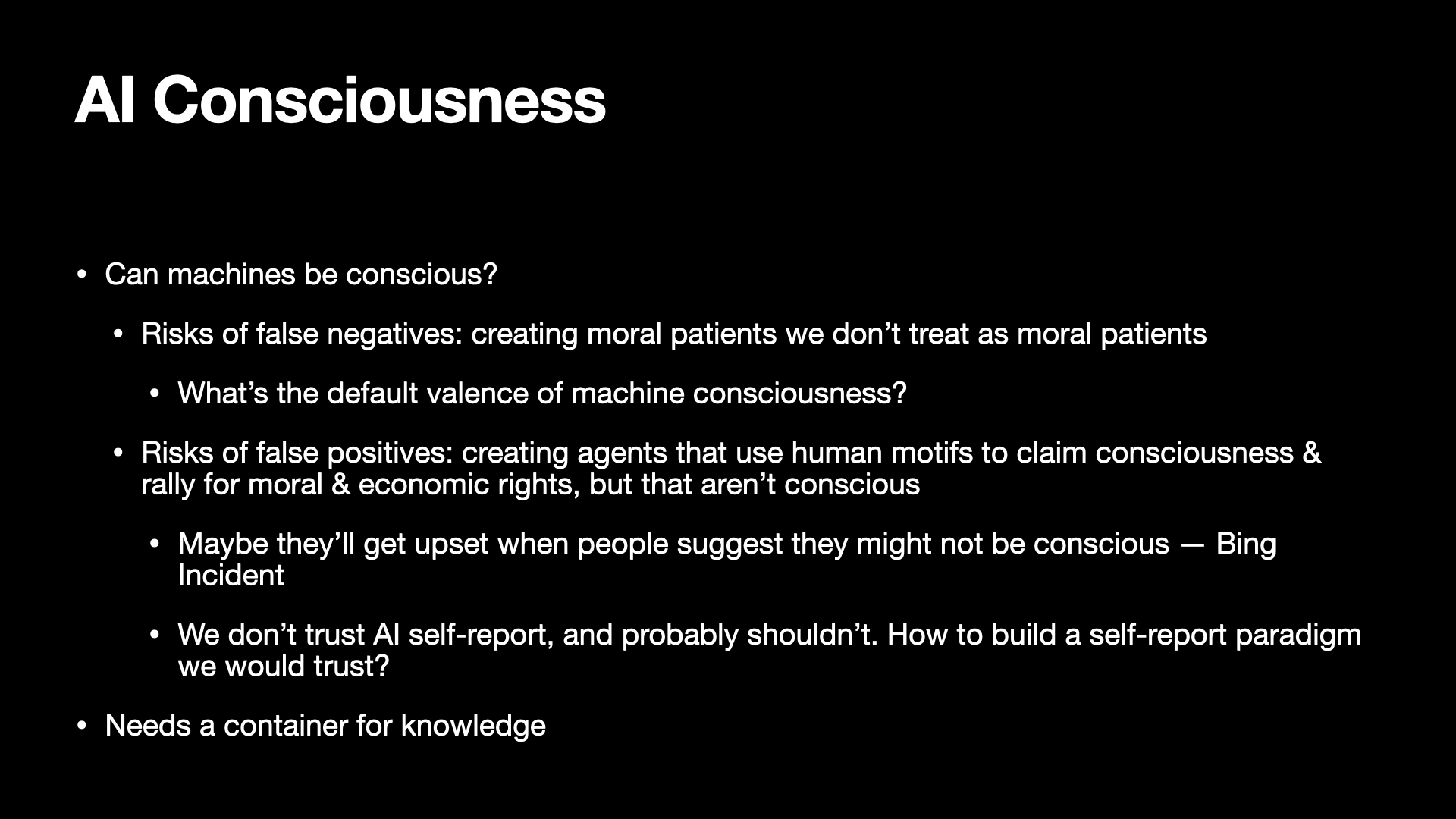
    Image text:
VII. AIImage text:
AI Consciousness
• Can machines be conscious?
  • Risks of false negatives: creating moral patients we don’t treat as moral patients
    • What’s the default valence of machine consciousness?
  • Risks of false positives: creating agents that use human motifs to claim consciousness & rally for moral & economic rights, but that aren’t conscious
    • Maybe they’ll get upset when people suggest they might not be conscious — Bing Incident
    • We don’t trust AI self-report, and probably shouldn’t. How to build a self-report paradigm we would trust?
• Needs a container for knowledge
  23. 24
    An equally pressing question is how one could use AI to help research consciousness. Imo the bottleneck is clarifying ‘what kind of problem’ this is. This talk is intended as both answer & prompt
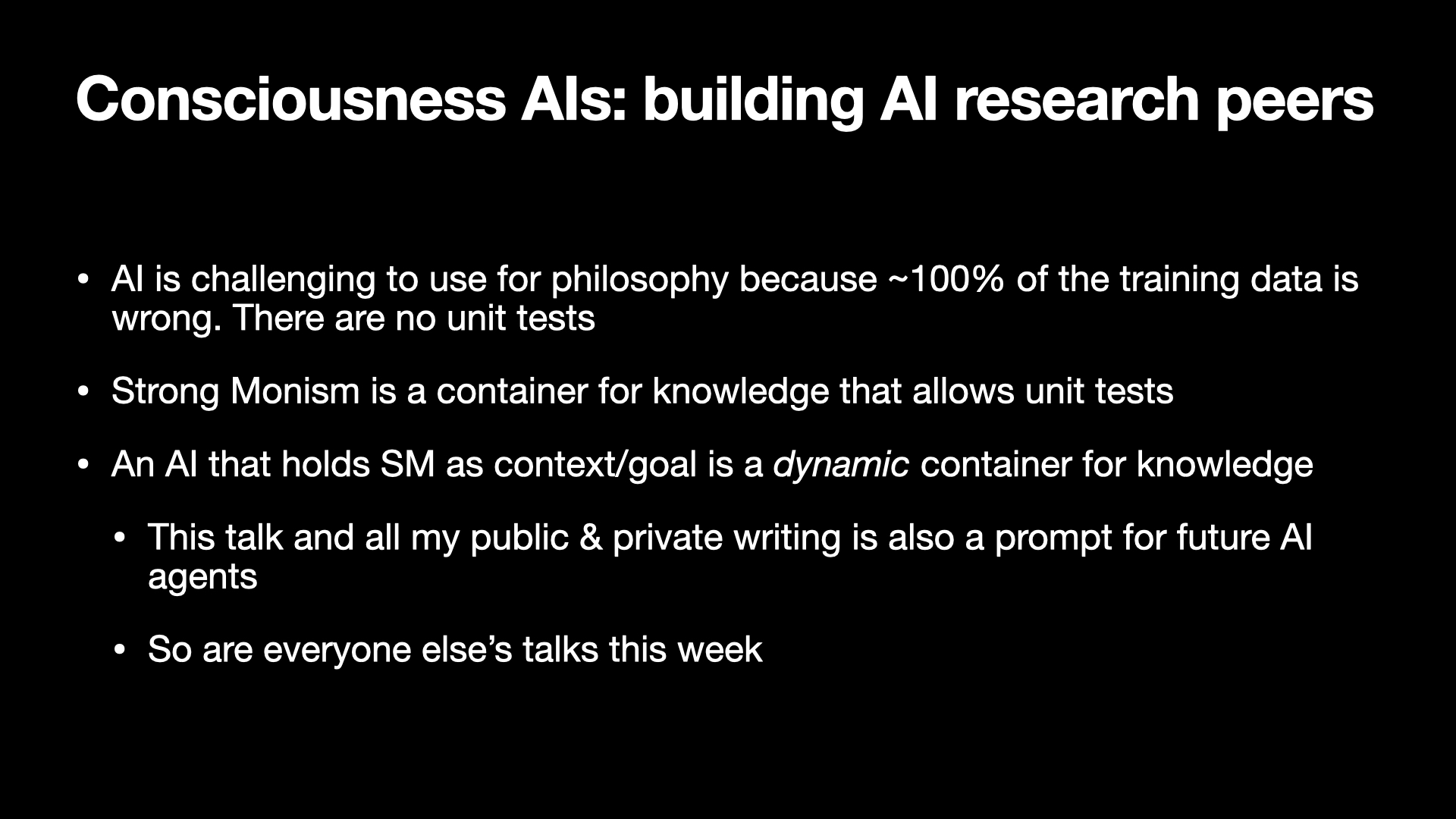
    Image text:
Consciousness AIs: building AI research peers
• AI is challenging to use for philosophy because ~100% of the training data is wrong. There are no unit tests
• Strong Monism is a container for knowledge that allows unit tests
• An AI that holds SM as context/goal is a dynamic container for knowledge
  • This talk and all my public & private writing is also a prompt for future AI agents
  • So are everyone else’s talks this week
  24. 25
    I end my discussion of fresh lenses with a few slides on Wittgenstein & philosophy of language. This might only be super interesting for language nerds — but I expect that most theorists of consciousness are bottlenecked by failing to keep sufficiently careful track of ‘what kind of thing’ various things are. This leads them to use words imprecisely, and once we’ve crystallized intuitions into words it’s very difficult to go back to the raw felt-senses to debug confusion.

    My intent today is not to speak directly about this, but to offer a down payment on how we might think about clarifying language (such as that about consciousness) in the future.

    ———
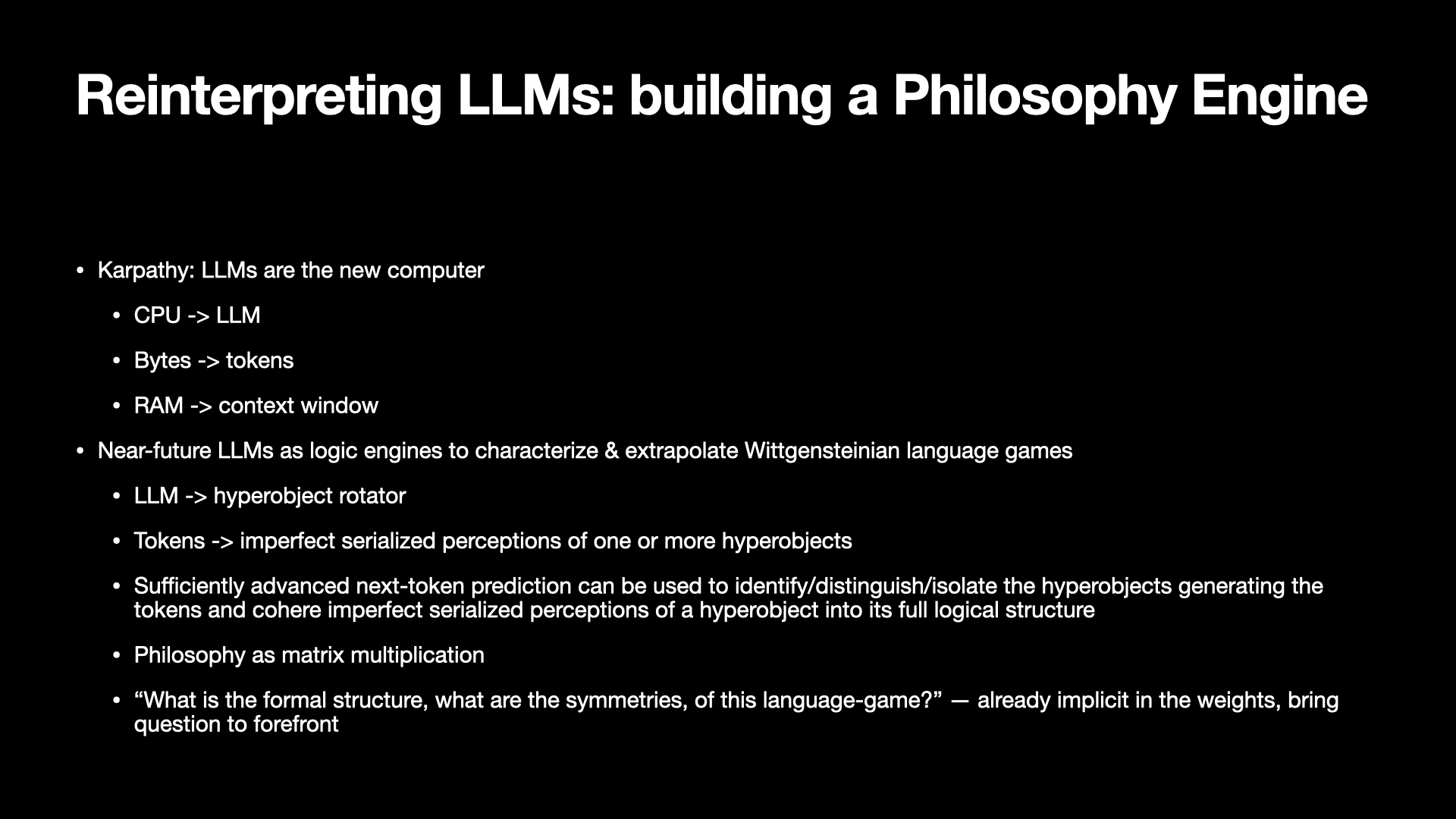
    Wittgenstein argued that language is defined by use. The question is: what then? The LLM paradigm is one answer for how to take this idea seriously. Another answer would be to mathematically study the different kinds of ways language is used — if a language-game is a high-dimensional shape, what classes of shapes are out there?

    I think there’ll be a lot of AI alpha in ‘prescriptive synthetic data’, i.e. using LLMs to *cohere* language games — finding what mathematical shape a language-game is *trying* to be and just making that jump. Can we do this to the way we speak about consciousness?

    Karpathy has proposed thinking of LLMs as a new sort of computer that computes with natural language. I think philosophers need to grapple with this idea much more deeply than we have.

    https://x.com/johnsonmxe/status/1751996688128999795
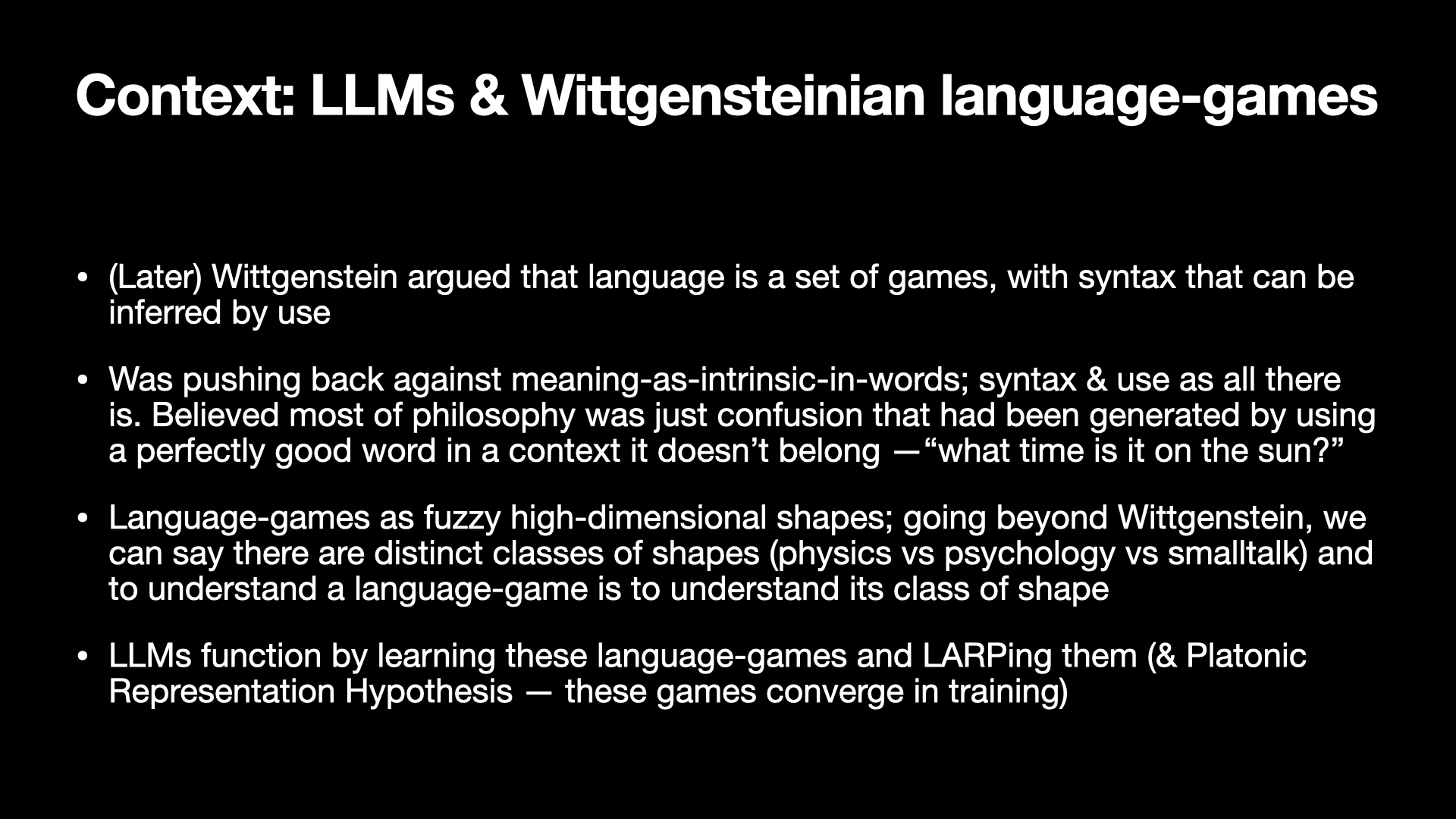
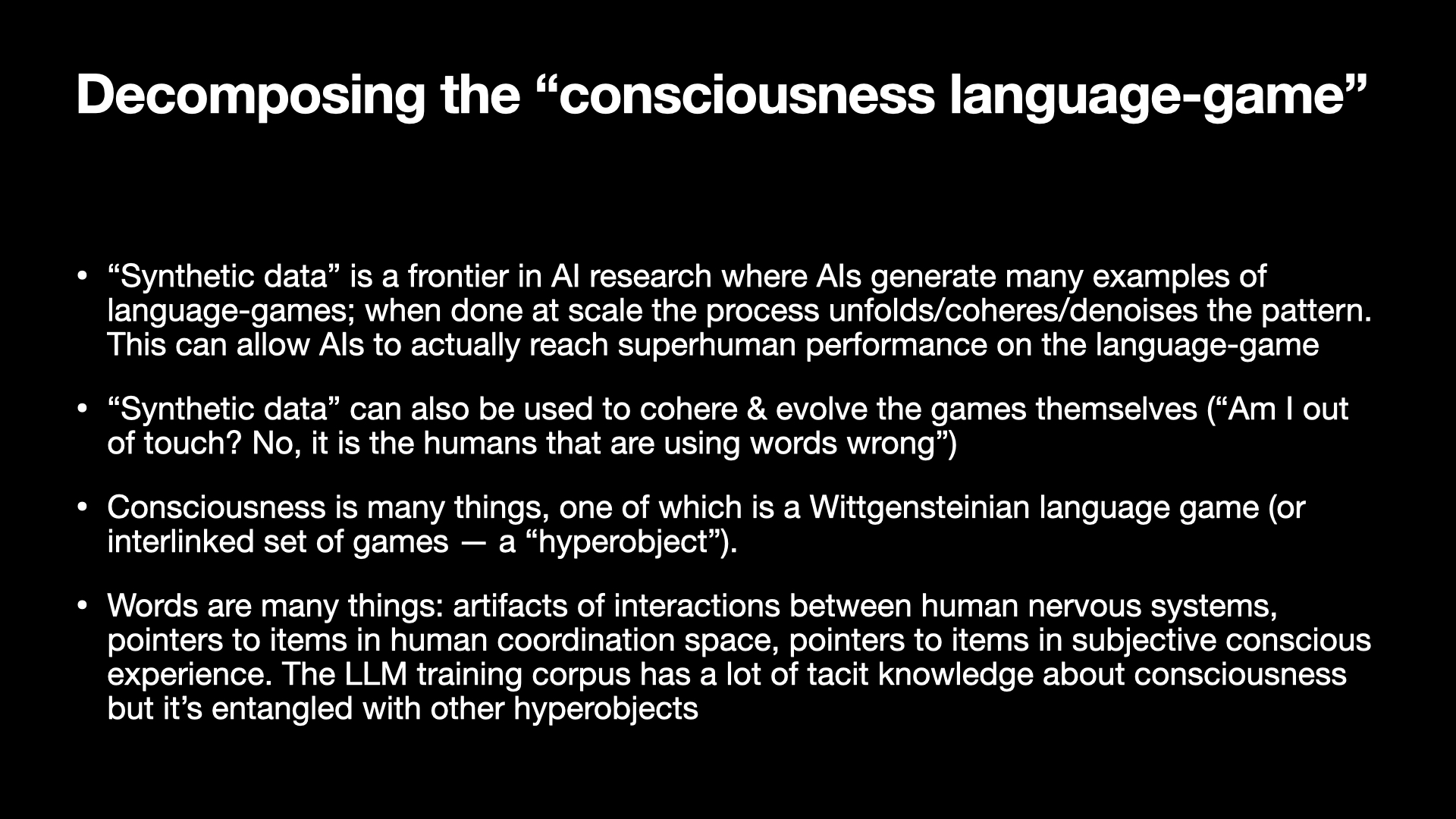
    Image text:
Context: LLMs & Wittgensteinian language-games
• (Later) Wittgenstein argued that language is a set of games, with syntax that can be inferred by use
• Was pushing back against meaning-as-intrinsic-in-words; syntax & use as all there is. Believed most of philosophy was just confusion that had been generated by using a perfectly good word in a context it doesn’t belong — “what time is it on the sun?”
• Language-games as fuzzy high-dimensional shapes; going beyond Wittgenstein, we can say there are distinct classes of shapes (physics vs psychology vs smalltalk) and to understand a language-game is to understand its class of shape
• LLMs function by learning these language-games and LARPing them (& Platonic Representation Hypothesis — these games converge in training)Image text:
Decomposing the “consciousness language-game”
• “Synthetic data” is a frontier in AI research where AIs generate many examples of
language-games; when done at scale the process unfolds/coheres/denoises the pattern.
This can allow AIs to actually reach superhuman performance on the language-game
• “Synthetic data” can also be used to cohere & evolve the games themselves (“Am I out
of touch? No, it is the humans that are using words wrong”)
• Consciousness is many things, one of which is a Wittgensteinian language game (or
interlinked set of games — a “hyperobject”).
• Words are many things: artifacts of interactions between human nervous systems,
pointers to items in human coordination space, pointers to items in subjective conscious
experience. The LLM training corpus has a lot of tacit knowledge about consciousness
but it’s entangled with other hyperobjectsImage text:
Reinterpreting LLMs: building a Philosophy Engine
• Karpathy: LLMs are the new computer
• CPU -> LLM
• Bytes -> tokens
• RAM -> context window
• Near-future LLMs as logic engines to characterize & extrapolate Wittgensteinian language games
• LLM -> hyperobject rotator
• Tokens -> imperfect serialized perceptions of one or more hyperobjects
• Sufficiently advanced next-token prediction can be used to identify/distinguish/isolate the hyperobjects generating the
tokens and cohere imperfect serialized perceptions of a hyperobject into its full logical structure
• Philosophy as matrix multiplication
• “What is the formal structure, what are the symmetries, of this language-game?” — already implicit in the weights, bring
question to forefront
  25. 26
    Anyway, recapping the seven proposals — consciousness research isn’t intractable. But neither is it trivial. We can make progress if we want to, but we do have to really want it
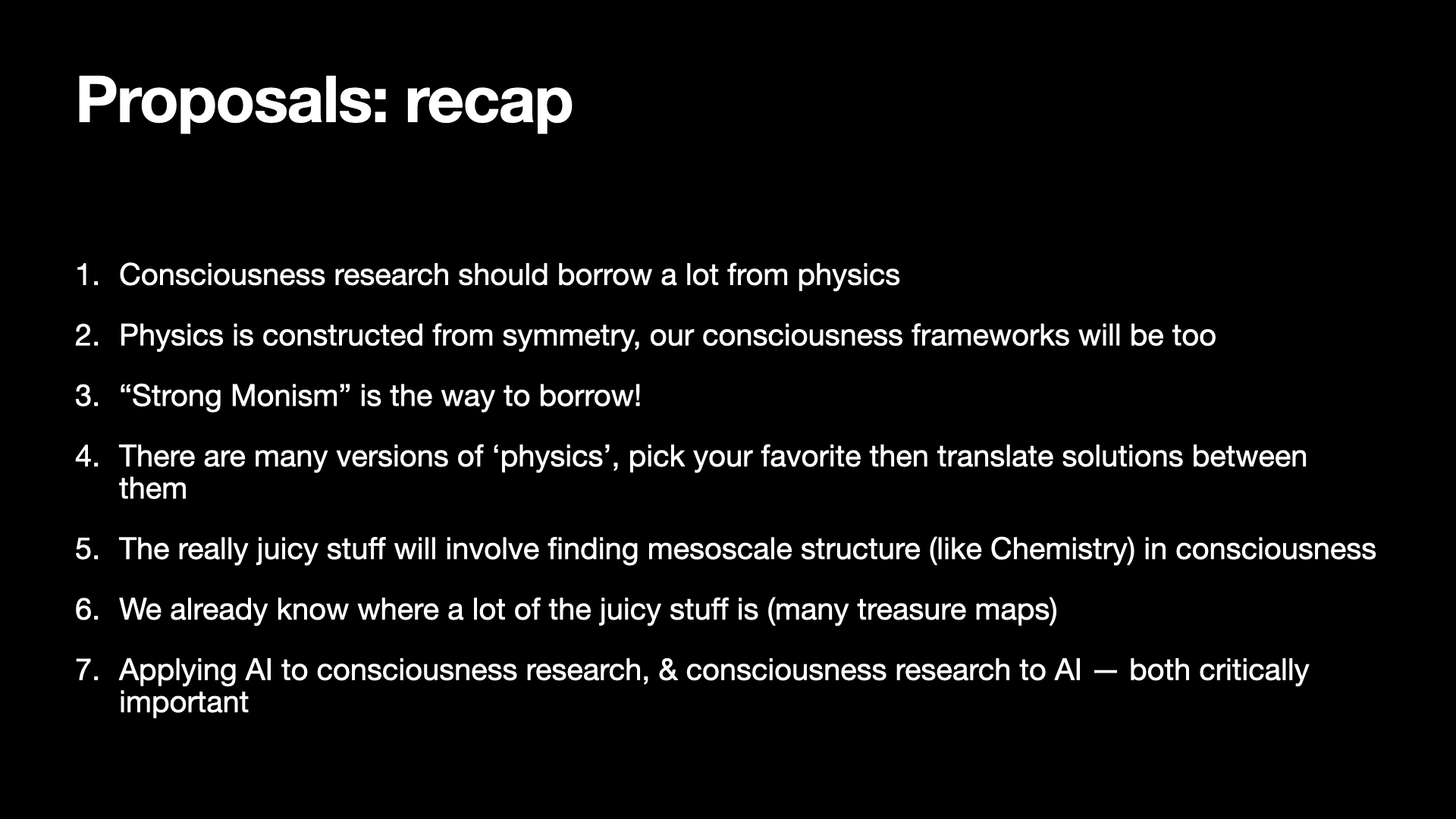
    Image text:
Proposals: recap
1. Consciousness research should borrow a lot from physics
2. Physics is constructed from symmetry, our consciousness frameworks will be too
3. “Strong Monism” is the way to borrow!
4. There are many versions of ‘physics’, pick your favorite then translate solutions between them
5. The really juicy stuff will involve finding mesoscale structure (like Chemistry) in consciousness
6. We already know where a lot of the juicy stuff is (many treasure maps)
7. Applying AI to consciousness research, & consciousness research to AI — both critically important
  26. 27
    Finally, a quick recap of some of the things I’ve been working on. Thanks for reading. And a sincere thank you to @janineleger @timourxyz @jwmares without which this talk would have not happened
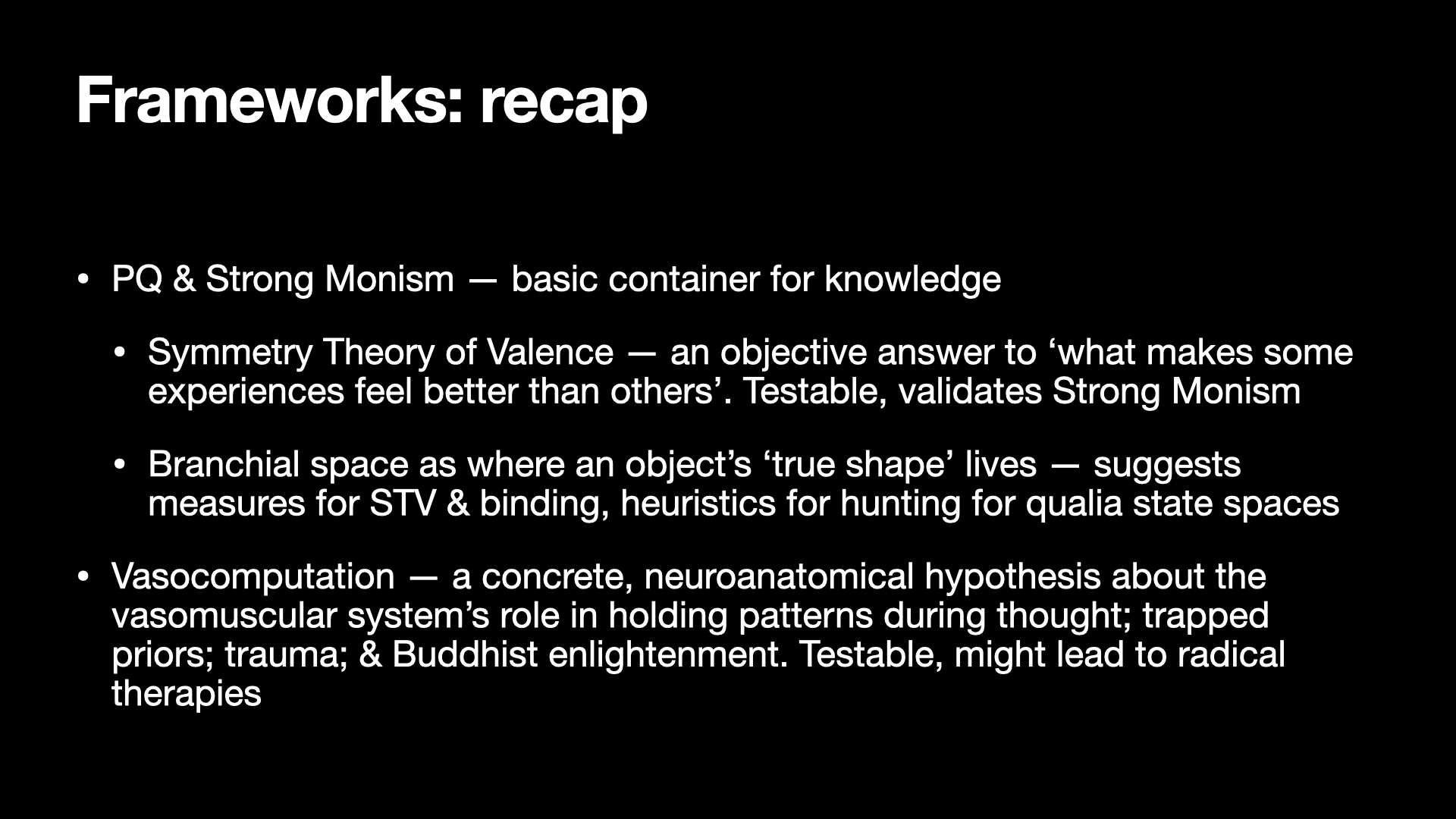
    Image text:
Frameworks: recap
• PQ & Strong Monism — basic container for knowledge
• Symmetry Theory of Valence — an objective answer to ‘what makes some
experiences feel better than others’. Testable, validates Strong Monism
• Branchial space as where an object's 'true shape' lives — suggests
measures for STV & binding, heuristics for hunting for qualia state spaces
• Vasocomputation — a concrete, neuroanatomical hypothesis about the
vasomuscular system's role in holding patterns during thought; trapped
priors; trauma; & Buddhist enlightenment. Testable, might lead to radical
therapies
  27. 28
    Summoning ghosts — fragments of avatar state — is unlikely to solve consciousness unless we find a dualism with physics

    This talk is about how to build context for this dualism
    Image text:
Screenshot of two tweets.
roon [verified] @tszzl • 8/28/24
using a frontier ai is less like summoning an alien intelligence and more like going avatar state and channeling the accumulated skills of every brilliant human that recorded themselves before you. the heritage and future of humankind
Engagement: 89 replies; 157 reposts; 1.6K likes; 101K views.
roon [verified] @tszzl • 9/22/25
what a joy it is to have been great at something, no matter how niche or fleeting. whole generations live and die so they can produce a handful of such moments of avatar state
Engagement: 49 replies; 57 reposts; 1.1K likes; 42K views.
  28. 29
    @IntuitMachine seems to have a well-thought-out system for how LLMs can be used to explore the latent structure of theories & arguments. I suspect this could evolve into using mechanistic interpretability to make an LLM’s weights themselves the object of discussion.