Vasocomputation and vascular tension
1 ↗ Last year I proposed “vasocomputation,” that vascular tension acts as a special type of memory that regulates neural dynamic range. Recently at @joinedgecity I shared some updates: how ‘thoughts’ are patterns of vascular tension, and implications for Buddhist enlightenment
1/x2 ↗ We were taught in school the vascular system is “plumbing for blood” — tubes that transport nutrients & waste. Vasocomputation suggests this misses 90% of what this system does — the vascular system adaptively shifts tension to help neurons compute
https://opentheory.net/2023/07/principles-of-vasocomputation-a-unification-of-buddhist-phenomenology-active-inference-and-physical-reflex-part-i/3 ↗ The core hypothesis: vasomuscular tension stabilizes local neural patterns. A sustained thought is a pattern of vascular clenching that reduces dynamic range in nearby neurons. The thought (congealed pattern) persists until the muscle relaxes4 ↗ Vascular clenches can also lock: smooth muscle has a “latch-bridge mechanism” that glues its actin & myosin together. This “semi-permanent clench” deprives neurons of blood, further preventing updates
We think with clenches; we set Bayesian priors with latches5 ↗ Tension has physiologically-distinct short- and long-term effects but there’s a unified grammar: tension prevents updating & reduces sensitivity to external patterns, acting as a “side-channel memory” about which part of the neural dynamic range to use6 ↗ My claim is that evolution took this simple grammar and built a general intelligence. Tension may feel unpleasant, but tension-as-frozen-sensation is a killer technology that allows imagination, planning, & communication. From an upcoming piece: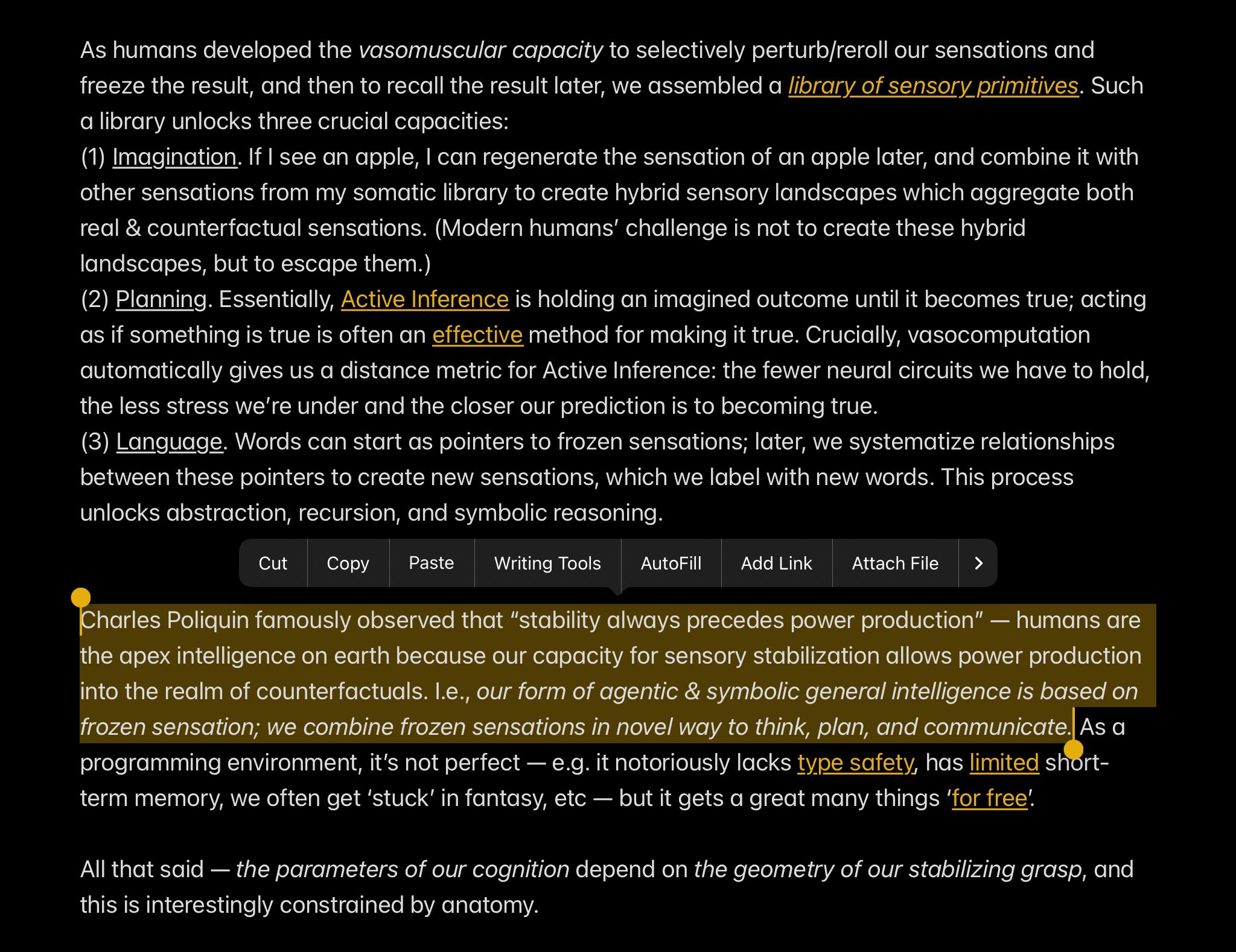
7 ↗ Vasocomputation suggests additions to leading neuro theories. Friston’s “Active Inference” framework needs a place for the body to store predictions; @drmichaellevin ’s Distributed Stress Minimization needs a way for stress to shape behavior. Vascular tension offers both8 ↗ My talk discussed two implications:
1. We build our inner worlds out of what we learn to stabilize & there’s important variation in this across people. Aphantasia is a skill issue: inability to flex vasculature in certain parts of the visual cortex9 ↗ Cognitive & emotional development is learning how to flex vasculature with more nuance & stabilize more patterns. Words are pointers to these frozen sensations; to understand a word is to be able to stabilize its pattern10 ↗ 2. Classical Buddhist Enlightenment is likely real and deals with opening vascular latches
We’re born into unoptimized sensory chaos, and progressively latch networks as we find good predictive solutions or dynamical regions that are unsafe11 ↗ Every new latch makes the system simpler & more narrowly useful, but also drains the sense of possibility and aliveness. Latches are semi-permanent tension and tension is costly12 ↗ We likely latch a specific cluster of networks when we’re ~1-3yo as we interact with and differentiate from The Other, and this semi-permanent tension constitutes the “self”. Most likely these latches are somewhere deep in the brain or brainstem
https://en.wikipedia.org/wiki/Erik_Erikson#Theory_of_personality h/t Romeo13 ↗ Latches are “frozen compute” — neural patterns that can’t update due to locked vascular tension. We can think of our amount of frozen sensation as our distance from non-dual experience14 ↗ As adults we grow our capacity to navigate the world without clenching — managing uncertainty on higher levels of abstraction. We could probably afford to reopen some of our latches and regain dynamical freedom. But latches are sticky; memory of what has been unsafe15 ↗ Vipassana meditation is a recipe for (1) building “nervous system virtue” for handling freedom, & (2) reopening latches. Engaging with raw sensation first requires a strong nervous system; then rapid noting generates rapid-fire prediction errors which may tease latches open16 ↗ Doing Vipassana well tells the body: “I can handle strange inputs without flinching. But here are some sensations we fail at predicting. If we reopen certain latches & regain our default dynamic range, perhaps we could predict them.”17 ↗ “Man is born free [but schizo], and everywhere he is in [vascular] chains.”
The moments of awakening are when these chains drop, but making yourself epistemologically virtuous enough to handle the freedom can take a long time and starts very boring18 ↗ Tangent 1: I’ve said before that psychedelics could be considered “vasocyclers” — I suspect classical psychedelic features can be derived by simply adding global low-frequency rhythmic energy to the vasomuscular system
From my notes: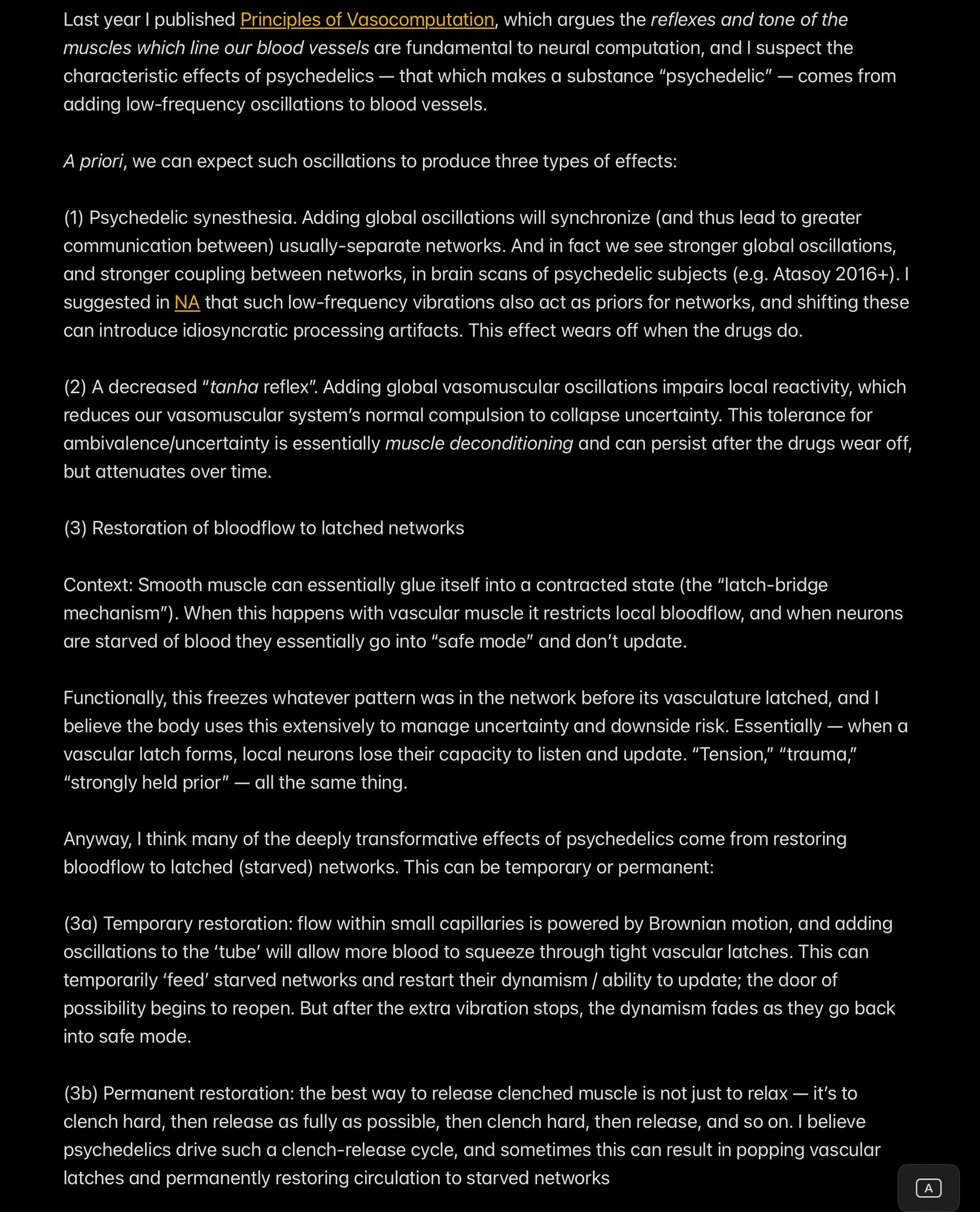
19 ↗ Tangent 2: this is why I go on about metabolism so much! If vasomuscular clenches essentially congeal or crystallize thoughts… what happens if this system has random microspasms? The texture of experience gets lumpy, in a very bad way20 ↗ Why is all this important? If there’s a process by which we can improve our daily experience by 10x (@ShinzenYoung ‘s estimate) we should try to understand it. If there is an elegant solution to be found, I believe Vasocomputation is it.
https://youtu.be/8P7q2MW5upg?si=tj-CUsPHeylUKwHg21 ↗ Another metaphor via @RomeoStevens76 is “penicillin for the soul.” Before antibiotics, a scrape could lead to infection & death. We seem to be at this stage for spiritual wounds. If vascular tension is where “the body keeps the score,” read-write access seems big22 ↗ This theory should be highly testable. A latch is a concrete physical thing; we can create neuroimaging maps of them & study their effects, conditions that form & dissolve them, etc. We can also make maps of “vasomuscular access” — where the Hand of the Mind can grip23 ↗ As a footnote, I expect some tFUS companies will pivot from neural to vasomuscular stimulation in ~1-3 years. Vascular state is the body’s natural programming language, and seems easier to hit with tFUS anyway24 ↗ There’s always the question of downside risk — much depends on whether ~50% of latches are safe to open without preparation, or ~99%. Meditation builds dynamical virtue over years and decades; some of that is probably resistant to shortcuts25 ↗ Anyway — vasocomputation is likely one of my two most important ideas, along with the Symmetry Theory of Valence. I am best at 0-1. Less good at 1-n. I believe there is something really valuable here. Please reach out if you’d like to help.26 ↗ And a big thanks to @insideNiMA and Warren Winter for organizing the neuro track at Edge City Lanna, and for hosting my research. The counterfactual impact for my research is very large27 ↗ Research context:
⁃Johnson, M.E. (2023). Principles of Vasocomputation: A Unification of Buddhist Phenomenology, Active Inference, and Physical Reflex (Part I)
⁃Moore, C., & Cao, R. (2008). The hemo-neural hypothesis: on the role of blood flow in information processing
⁃Jacob, M., et al. (2023). Cognition is entangled with metabolism: relevance for resting-state EEG-fMRI
⁃Various works by John E. Sarno (see his “TMS” construct) and William Reich (see his “armoring” concept)
Additional resources:
⁃Sasaki, D., et al. (2024). Plastic vasomotion entrainment
⁃Murphy, R.A., and Rembold, C.M. (2005). The Latch-bridge Hypothesis of Smooth Muscle Contraction
⁃Ekstrom, A. (2020). Regional variation in neurovascular coupling and why we still lack a Rosetta Stone
⁃Wikipedia, accessed 17 July 2024. Sliding Filament Theory
⁃Holliman, C. (2023). The Intriguing World of Tensegrity: Fascia’s Role in Our Body
⁃Fields, C., et al. (2019). Morphological Coordination: A Common Ancestral Function Unifying Neural and Non-Neural Signaling
⁃Alexander, S. (2018). God help us, let’s try to understand Friston on Free Energy
⁃Friston, K. (2010). The free-energy principle: a unified brain theory?
⁃Parr, T., et al. (2022). Active Inference: The Free Energy Principle in Mind, Brain, and Behavior
⁃Ramstead, M., et al. (2023). On Bayesian mechanics: a physics of and by beliefs
⁃Safron, A. (2020). An Integrated World Modeling Theory (IWMT) of Consciousness
⁃McMillen, P., & Levin, M. (2024). Collective intelligence: A unifying concept for integrating biology across scales and substrates
Poasters that vasocomputation owes much to:
@nickcammarata
@nosilverv28 ↗ Thread of all talks in this series (all really high-quality):29 ↗ Adding my notes on VSMCs vs fascia to this thread